Unknown's avatar

About weavingtheseisles

An ex-educator, would-be musician and by-chance weaver, I’ve uprooted from a Dartmoor smallholding to travel the Anglo-Celtic Isles in a bus on a weavery investigation with a loom, a whistle and a hound, in search of autonomy and Celticness. I roam the most beautiful parts of Britain, Brittany and Ireland. My suppliers are local, my trade is online, my colleagues and customers are all over the world, and my inspiration is wherever I park.

On ‘home’ again: among the geese and sheep in the cattle market

I’m about to leave again. I’ve been in Devon for a month, on a hare-paced pit-stop. Sitting in my driver’s seat in the dark and opening my laptop feels reassuringly like being on the road. I’m parked up in a mechanic’s yard – also reassuringly like being on the road, but with the warm knowledge that my good friend, who has just helped my three-month-long boiler frustration conclude, will fix my fridge tomorrow and send me off.

During my month in Devon, which feels happily like a visit, I’ve caught up with some of my favourite people, sadly missed others, and done a couple of impromptu photoshoots. This one was going to have a ‘Devon harvest’ theme…

…but went a bit Gaucho, again…

I’ve done *some* of the bureaucracy I should have, and traded at my first market event with the woves.

I was invited to sell my wares at the cattle market at Goose Fair. Goose Fair completely takes over Tavistock for the second Wednesday in October, closing many of the roads and all the schools. Once a purely livestock sale, it now consists of a funfair and hundreds of stalls of plastic tat with pro salesmen whose theatrical pitches are almost worth watching in their own right. There are churros stands, burger vans and candy floss, but the goldfish of old are scarce or absent – are they still even legal? How many did you flush down the loo in your childhood?

Anyway, I’m not expecting to sell many expensive British-made weavings, but I’m drawn to trading here because it is ordinary: not the top end artisan glamour of the Contemporary Craft Fair; not the arty sophistication of cultured Chagford; but full of local, rural and Plymothian folk. I’m not among the plastic stalls, but among the poultry at the cattle market. The geese shout their heads off all day, poor loves.
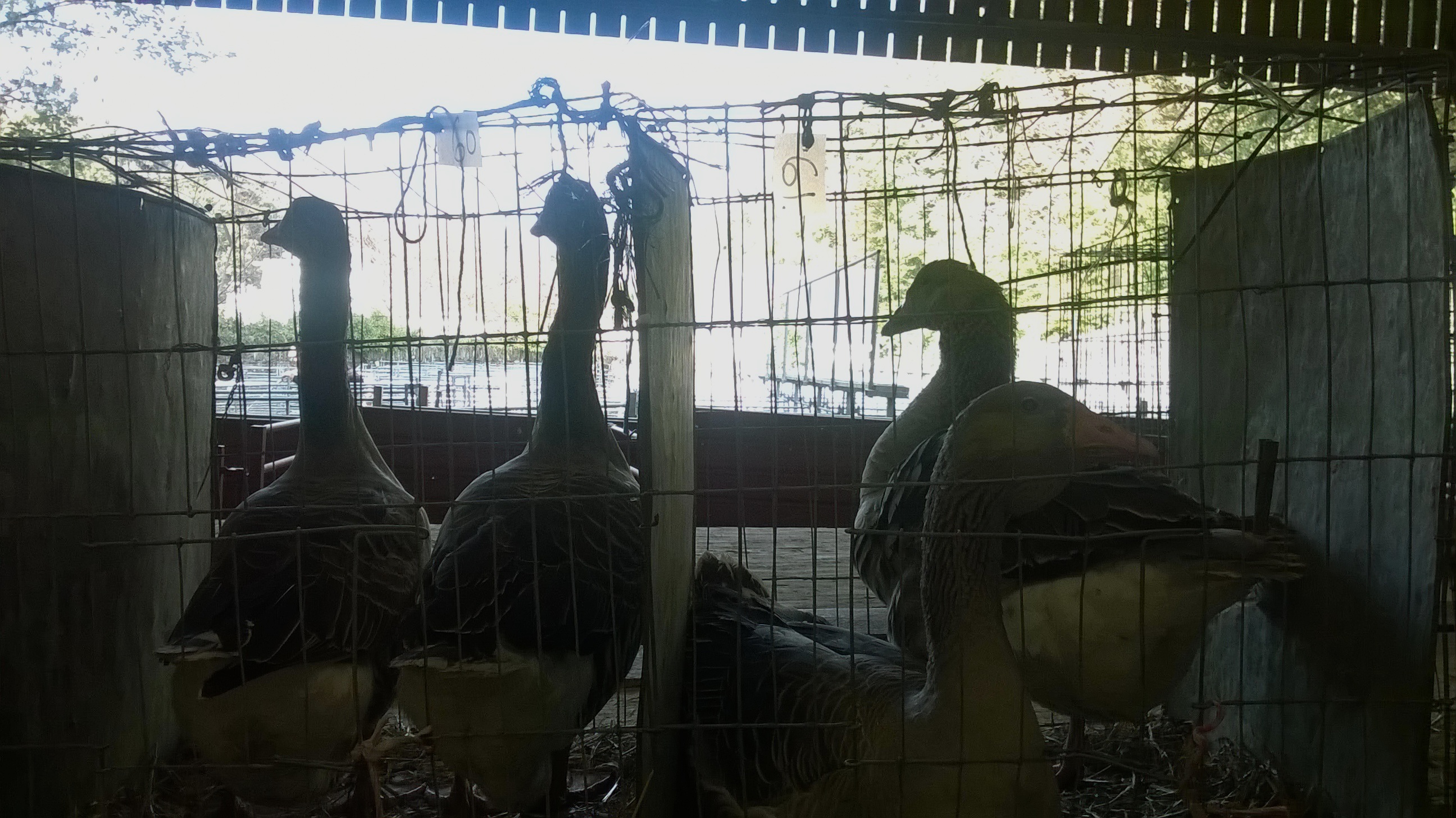
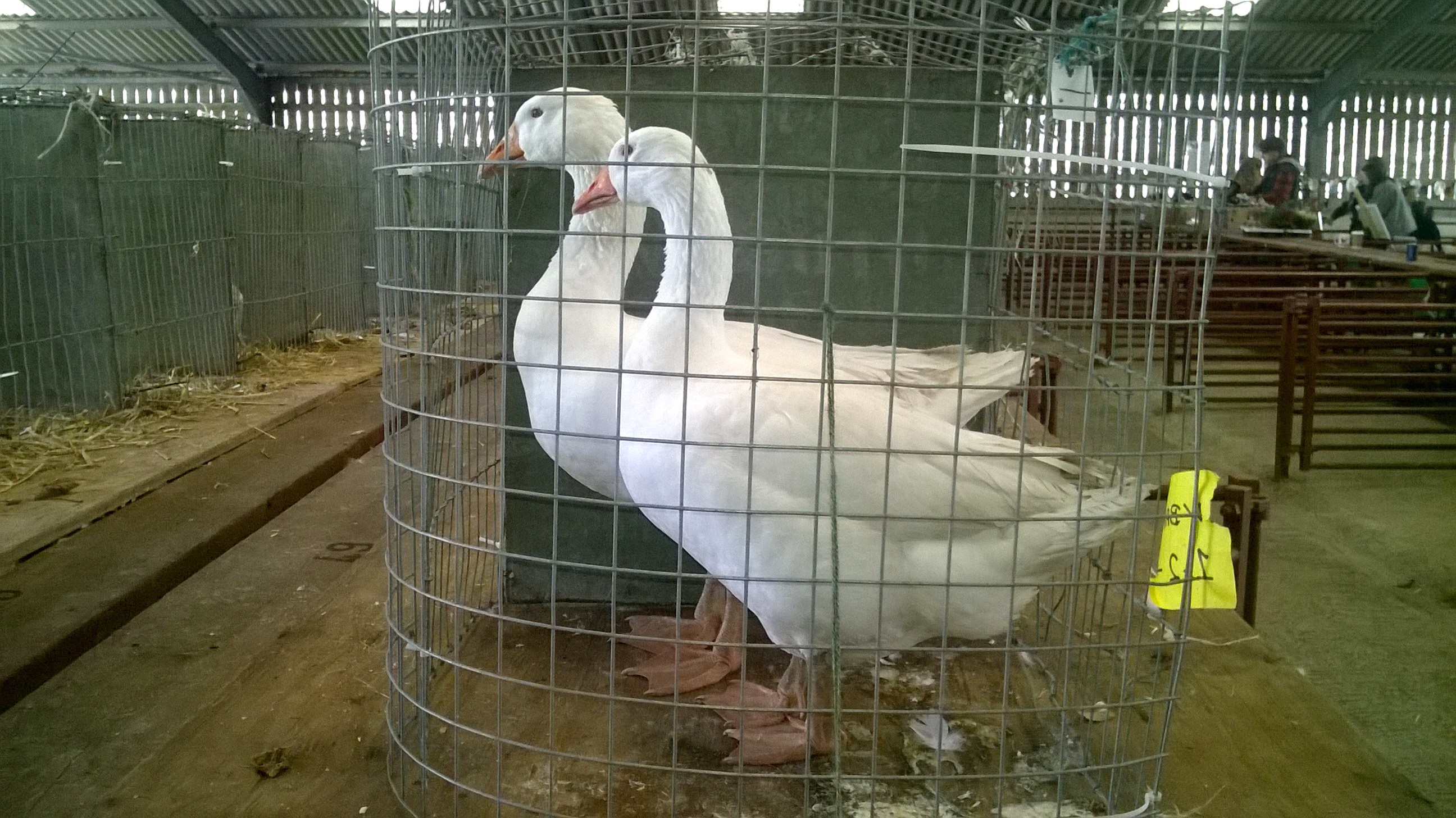
Geese White geese

The organiser hopes apologetically that I don’t mind being beside a penful of sheep. I grin, and tell her that that is why I agreed to come, because that is where I feel comfortable. Admittedly none of us had allowed for cow shit on the floor and railings behind our stalls, but someone produces some wet wipes (aaargh!) and it’s fine.

There are spinners and dyers and felters and Dartmoor Whiteface people and Dartmoor Greyface people and Jacob’s people, and we are a little showcase of British wool. Not surprisingly I am often invited to be part of events that promote hill farming in general, and sheep rearing in particular. I love wool, and loathe synthetic fleece. Farmers too often leave fleeces to rot, and if they sell them, are unlikely to cover the £2 per animal annual shearing cost. I am all in favour of Britain as producers and manufacturers, more than importers. I’ve always lived in farming country and feel concern for both animal welfare and struggling hill farmers’ welfare. Farmer neighbours have done me many a kindness over the years. And yet, when I watched the film of Huxley’s The Island, where human clones are farmed for their organs, I suddenly saw farming as a dark concept – though I still kept animals myself and my smallholding dreams are probably only dormant, not dead.

My mum, who brought me up vegetarian and who has now gone vegan while I’ve gone the other way, is a fierce voice of Monbiot ilk, and I too sympathise with rewilders and those who would see our moors empty, or at least emptier, of grazing animals so that they might reforest rather desertify. I also sympathise with certain ex-vegetarian friends who point out that the hill ponies offer the leanest, most natural, organic meat from animals with a very-nearly-wild life. At about midday I am filmed trying some pony meat. I talk to the camera about the many reasons why my first taste of horse is a challenge, and fear that I am betraying not only my equine friends but my veggie friend who runs a rehoming and training charity to promote the use of hill ponies for riding, driving and pack rather than for handbags or zoomeat in a dead market where farmers get just a few pounds per pony, on a good year, and shoot the ‘surplus’ that doesn’t sell. Thankfully many people are trying to make a positive difference for all in this sad situation. Meantime we all do our best, and rub along.

I have a lot of stock, and enjoy unwrapping it all to lay it out proudly on tables around my loom, which I’ve brought to demonstrate. Beside my stall stands my sentry willow sculpture mannequin that a kind ex helped me make years ago for displaying the upcycled dresses I used to design. Before I’ve finished setting up I’ve had to dig into my box of incomplete woves for a lovely, tiny, humble Quaker woman I know who buys a small piece of blanketry as a back-warmer to lie on. Later in the morning another humble character borrows cash from his friends to buy my Emerald Isle scarf for himself. Both sales surprise me, and I am pleased. There is a constant stream of people who look closely at my woves and take cards and give compliments. At least three lovely women take pictures of the stall and ask to publish them on their blogs, or in one case, a local rag, and I am delighted. I meet Seth Lakeman’s violin teacher, who promises to give me a weaving contact in County Sligo. I see old friends, neighbours and acquaintances. We are well looked after. It is a good day, and I am glad that it can work in such an unpretentious setting.

Afterwards I have a date with a ten year old on the dodgems, which are bumper cars as far as we’re concerned. We eat candy floss, chips and sweets. ‘Scream for speed!’ Young memories of 2CV soft tops and Landrover backs open to the stars on fast journeys home to ‘Tunnel of Love’ mean I always love the noise and lights and shadows of the fair.

And now I am ready for my winter destination: Brittany, tomorrow.

Journey through the music from the far North West to the far South West

Coming back to ‘civilisation’ was hard. I didn’t want to. After resting up in Husinish for a few days to muster the energy for the southward migration, I headed to my aunt’s home on the mainland above Ullapool. Never having visited her before, it was great to turn the wheel procrastinatingly north again, and wind through a few glens to get there. However, even the NW Highlands felt developed compared to the rugged Outer Isles I’d hated leaving. But her little Hobbity hamlet stood on a little green hill bathed in watery sunlight and perfectly overarched by a rainbow, and, looking to the West, I saw that ‘her’ two mountains were the same distinctive silhouettes that someone had pointed out to me from Tolstadh, East Lewis. ‘If you can see the mainland from here, it’s going to rain. If you can’t see the mainland from here, it’s raining.’ And there I arrived just behind the same crags that she calls hers. I couldn’t see Lewis, so it must have been raining. Chances are.

In limbo, even the weather stayed still – unheard of, apparently. We nattered ourselves all out, and I worked on a Devon hedgerow blanket for my mum’s upcoming Big Birthday. Then on the warmest day I’d experienced all summer, I got cheerfully back into the driver’s seat and, singing, drove all day through the (relatively) dry-looking Highlands on the only road through them that I’d not yet taken.

I had quite a decompression plan. Like sleeping on a beach the night after the end of a festival, one needs a long, golden bridge when crossing from the Other World back into This.

And so I and fortune had aligned my dates so that, earlier than originally planned but later than latterly intended, my trip south would take me via a gig of my biggest musical hero, John Doyle. A little folk club in East Scotland had booked him in what they’d called the ‘coup of their year’. Once before, hounds (two, that time) and I had found a great musician and a friendly welcome there on a similar rite-of-passage journey. On that other journey three years ago, with a broken heart, I had been on a recky to see what vardo-living might be like in Scotland. And so now, having made the leap into (albeit-102-horsepower) nomadry, it seemed right to catch John at that particular venue, and indeed it was gorgeous. I even overnighted in the same lay-by as that other time, and felt happy and safe and well.

My concept of home has mutated drastically: home is now simply faith.

So when, the next evening, aiming for the Cumbrian coast, I overshot and suddenly had to limp off the motorway near Morecambe clutchless again, it was ok. It just meant that, thanks to the AA (again), I met another nice mechanic and now know one in Lancashire too. On the advice of superhero Stornoway and Devon mechanics I was carrying a replacement slave cylinder in case the master replacement was not the whole solution, and superhero recovery mechanic Chris put me back on the road without fuss. And, little van working hard and going well, I pressed on all the way to Gloucester services and stayed overnight there – though beware, they charge more than a campsite, such that I begrudged them the price of breakfast (admittedly the best service station breakfast available, I’d found on my way north, with free range local meat and fresh squeezed vegetable juices) and forewent. But it was nice not to have to leave at silly-o’clock in the morning, and have time to be emotional, and then, on the M5, sing my heart out to the old Levelling the Land album, and then write a song in that spirit.

Still not yet fully decompressed (as I’d envisaged a day or two’s weaving in the beautiful Lakes), I phoned a rambling Devon friend and we met on a bit of Dartmoor I’d never met before and walked and chattered in the beautiful September sunshine, until at last I was ready to re-enter.

And then a whirlwind month of endless boiler stress, head gasket stress (did I mention the diagnosis by Iain in Stornoway, even though these engines are not supposed to have those difficulties?), money stress, HMRC stress, customers and orders, bad-warp-choice stress, and order cancellation stress…

I camped in SW Cornwall for three beautiful equinoctial days with my mum for her Big Birthday. We ate and drank and walked the dogs and rested in the sun (apart from when I was working) and it was great. Given how Hebridean the landscape is in Penwith, it was surreal how warm the weather, calm the sea and tropical the vegetation. All wrong, in fact.

We met a Poldark extra on an evening beach and my mum tried her usual matchmaking, but I wasn’t interested. We visited the set where they’re currently filming in a nearby cove and nosed among handwoven willow lobster creels and nets and old tools and centuries-old buildings – I was interested in that, it was magical. The moon rose big and bright over the sea and on the next headland the Cornish Proms rang out from the cliff-built Minack amphitheatre as the ships motored through the busy Channel.

On my way back through Cornwall I visited Horse, who is very well, which made me happy.

There was another visit which I have postponed until next year: an exciting commission for a number of seasonal wall hangings of a Cornish garden, artist-in-residence style. We’ve got excited over photos and Harris tweed yarn colours and textures and I nearly squeezed it into a little window but realised that, despite dire need for the money, it was not a job to squeeze into a little window. Art before bank, and the time that time takes, or life gets unhappy. The bills will be paid somehow.

There has been fantastic songmaking with my musical accomplices on guitar and cello. Our trio has surged forwards, nervously but successfully supporting a known act (Jim Causley) in a Devon folk club on our first ever outing, and being treated like special guests at other folk clubs thereafter as we gigged instead of rehearsed (though that was definitely a mistake for at least one song). HUGE thanks and appreciation to David and Jo, as we mostly pulled off our tricky arrangements. ‘Pentangle’ said our first host, and ‘Sandy Denny’, said someone else of our Planxty arrangement. We are onto something, though I say so myself. But have a lot of work ahead.

I find I love folk clubs, and love just how much there is going on around dear old Dartmoor, whose  pubs are full of geeky, rustic, humble, proud, pagan, farming, labouring, beautiful, tuneful specialists, with haunting local and far-flung songs to mine.

Now isn’t that the Celticness I was looking for? Right here at home all the time, if only I’d known how to look. Of course.

Partings, losses, endings: sailing from Stornoway

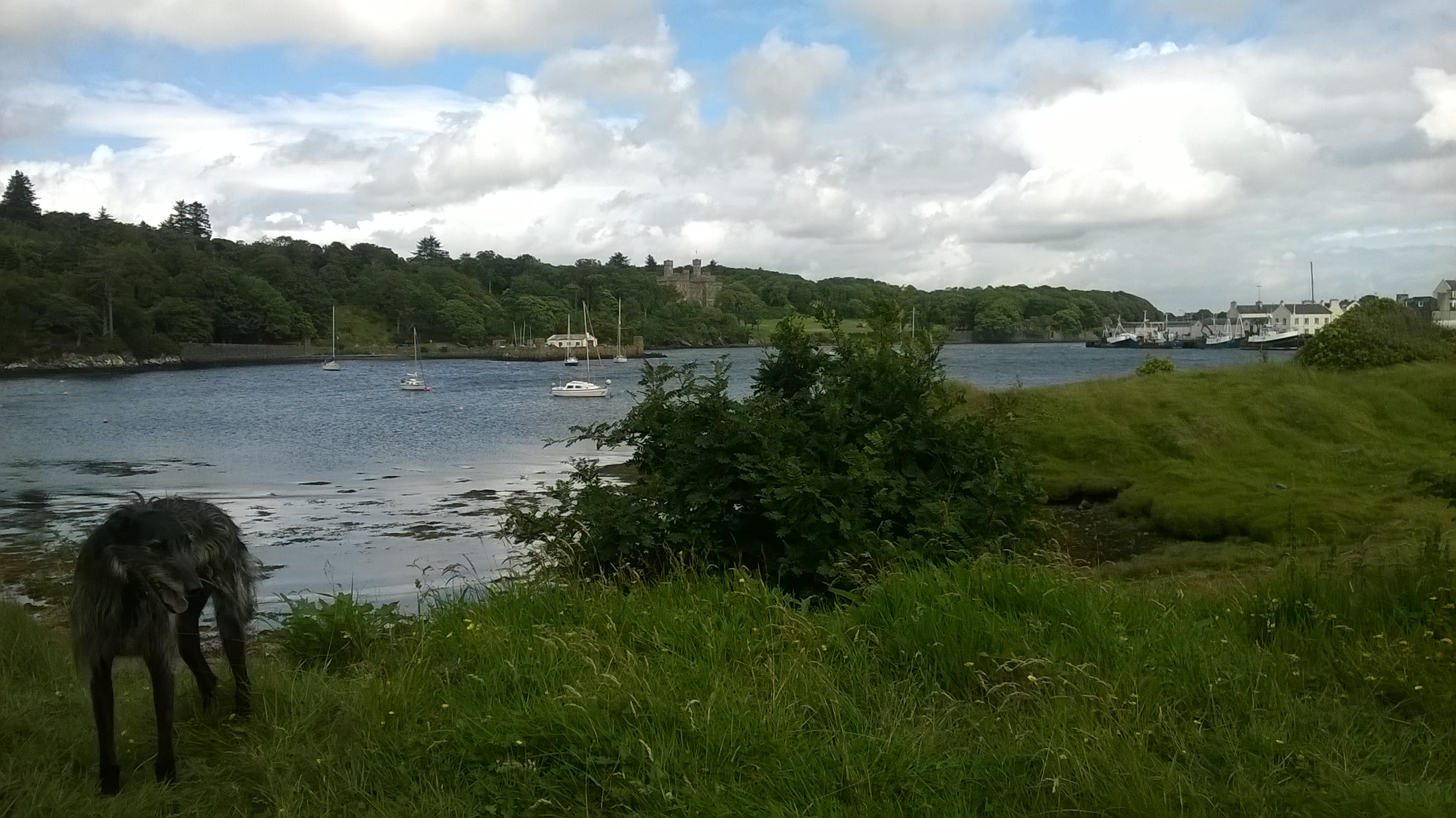
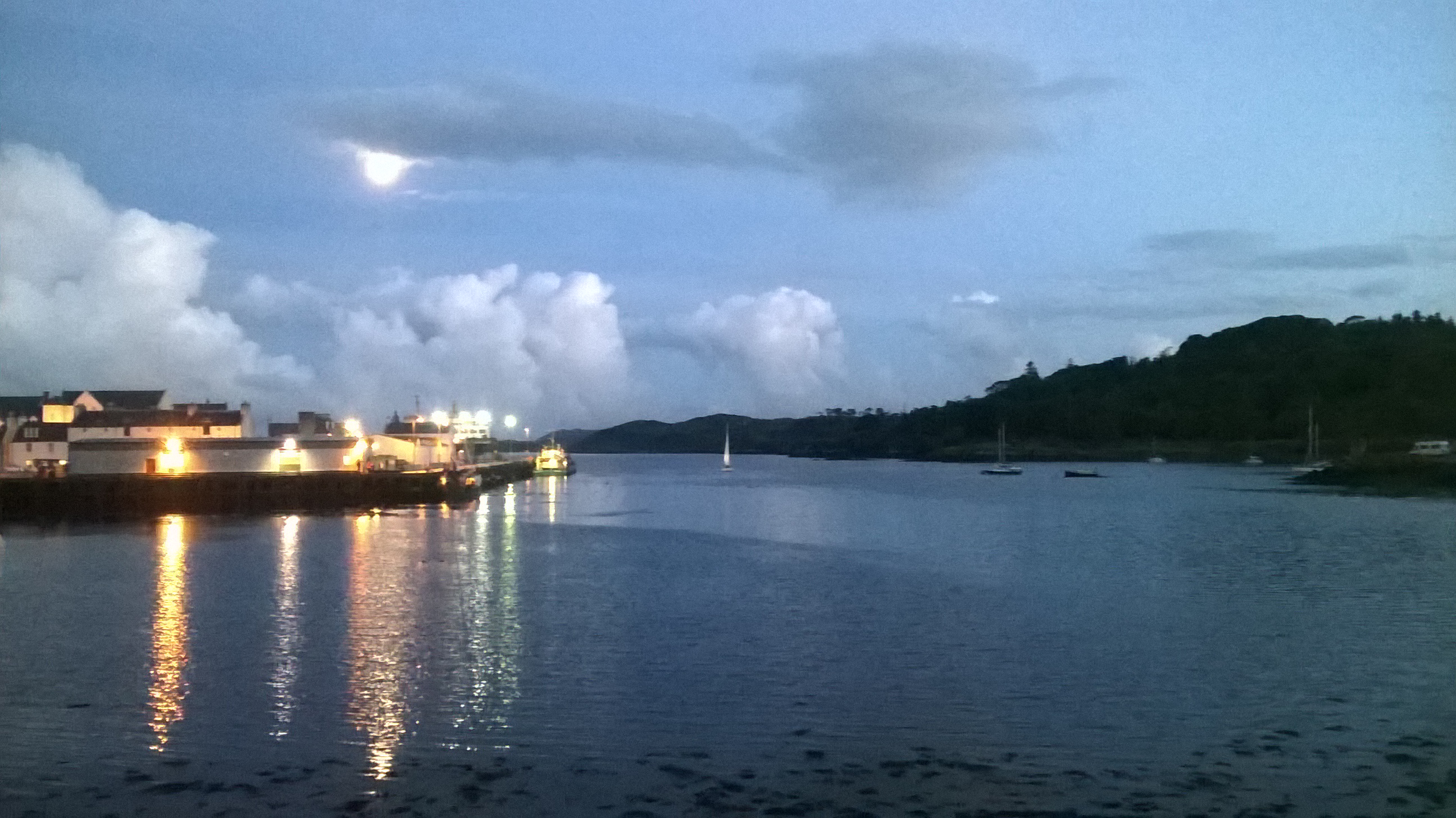
On my last evening I park by the slipway at Cuddy Point and watch part of a rusty moon peer through the clouds over Stornoway’s inner harbour. I’ve said a few sad goodbyes, which I hope are so longs. I’ve made more friends even in the last days, walking Murph in the wooded castle grounds and sharing the paths with a couple of lovely women. On my last morning I buy lichen-coloured tweed, say some more farewells, and quell tears and departure-nausea as two walkers watch the ferry turn from the rocky woodland above the parking spot I left just an hour ago. I am sad not to have seen Joe, a wildlife tour guide I met on Mull last year with plans to move to Stornoway but whose number I lost. I am sad not to have made it to the St. Kilda swimmers’ party. I am sad not to have visited Cathy and her weaver husband at Achmore. I am sad not to be able to join the next session in An Lanntair or the next singaround in the Carlton or the next gig in the Retirement Centre. I am sad that I didn’t follow up Angus and Violet’s invitation to retreat to their self-catering cottage. I am sad that that crystal blue day at Husinish did not last forever. I am sad that the West Harris Trust are seeking new residents and I am not one. I am sad that there is a great crofthouse in the most beautiful corner of Lewis that I could rent if the world were different. I am sad about all of this and something more. I am sad about the empty holiday houses throughout the Hebrides and South West and everywhere else; the struggling rural communities that cannot fill pubs, buses or sustain post offices; the careless building in beautiful wilderness; the uncertainty of not knowing where my home is; the Syrian and other refugees dying for want of a safe home. And something more. Paths untrodden, opportunities unpursued, and loss: that which we could maybe have had but cannot, or choose not to, even without knowing why. The ferry rolls gently but my stomach doesn’t like it, and Leodhais, island of the materially poor, cultural millionaires, has disappeared into the fog.

Retreat to Husinish: a dead selkie, a farewell, and thanks

WP_20150831_20_25_55_Pro

My clutch pedal good and firm, I head back through and around the hills of North Harris where I will park up and weave for my last week on this island. After being Wi-Fried in town for more days than my system likes, I need to escape to the edge. I’m thinking of the white-lit blue spot in the dunes, but there is someone there, and when they vacate it the next morning, I am ready to appropriate a futher-away pull-in nestled between bends on the road above, and which has a burn tumbling through it.

WP_20150902_10_19_28_Pro

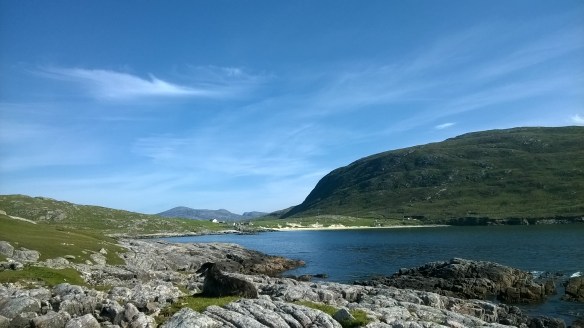
There is a path I’ve not yet taken: Northwards to uninhabited Loch Erisort, with the island of Scarp to the West, wends a steep and roughly paved path that could almost have been built by Romans (had they ever made it here). I’ve seen a spit of sand but am unprepared for the vastness of yet another stunning beach that is surely the most remote of this remote area on this remote island. We pass a few other walkers and there are century-old cairns on the ridges but the landscape is so big and so inaccessible and so little inhabited that even so, it feels like virgin territory. It feels as if I’m on a desert island, and it is sublime.

*

It’s a Monday evening. I’m preparing to leave these islands for this year, and it is hard. I’m sitting in my cosily-lit but dish-piled van listening to the sound of the burn falling down the rock into this muddy, quarry-like lay-by and eating a favourite salad of puy lentils, pomegranate, feta, lemon and mint. My bleak spot is slightly hidden but the white bay and croft houses are within sight and sound. I’ve just come in from a shorter walk: the routine evening stroll along NW Harris’ Caribbean shallows.

Just above the burrl of kelpy tideline, a dead thing caught my eye. I nudged it with my toe, couldn’t identify it – a weirdy weed, strange plant, sinewy and fingered – and walked on, and stopped, and walked back, and nudged it again, and turned it over, and touched  it. Fingers, metatarsals, skin a drowned grey, two hands, an arm bone.

Horror, fear, responsibility, evasion, guilt, dread, doubt.

Left brain: people die at sea, no big deal, c’est la vie. Call the police? Again? Missing person? Mystery solved? Relatives able to grieve?

Left brain: nearest signal?

Left brain: you’re imagining it. Don’t be ridiculous.

I walk back up the hill home, hesitant, still no signal. Then pick up a pace: those holiday makers did invite me to use their amenities if I needed. Freak them out with dismemberings at darkfall?

Right brain flash of lateral knowing: seal. A seal. A seal has died at sea. Seals must die at sea all the time. I have a dark writerly friend down South who is unflapped by my weird worryings:

’T, far from proper comms: please could you Google pictures of seal flipper skeletal structure ASAP and tell me it’s very similar to human hands so I don’t drive miles for a phone signal to make an erroneous report to the police of missing person body parts washed up on the beach? In particular, does a seal have a largish bone connecting flipper to shoulder? Thanks. E. x’

Sorry dear Selkie ones, but I’m hoping that it’s one of you.

*

And so I come to thinking about my fantastic support team: Tom, who won’t freak when I’m scared, and who offers social media help for my business; Will, who said he’d get in the car and come and find me any time I was in trouble; David, who gets in the car and travels hundreds or even thousands of miles for me and the music; my mum, who mothers me finely and who will give me a refuge in Brittany this winter; Chris N, whose address I use; Mark, rock, knight and carer of all things vehicular; Chris D, for maps, devices, podcasts, random-seeming-but-dead-relevant nuggets of solid gold, and all things expeditionary; Penny, who has taken on my beloved Horse; Nat, who keeps my beautiful yurt; Kat, who homes my old piano; Rich, who is out there too, blazing a trail, paving the way, sleeping under a tarp or not even, inspiring and encouraging; Amy, who prompted me to write and keeps egging me on; Sarah and Philippa and many others for reading and complimenting; and all of you for following, liking, buying, commenting, sharing. Thank you.

In which I finish the blanket, enjoy a singaround, return to Harris, meet with my main musical accomplice, attempt a return to Husinish, and drive 25 miles back to town all in one gear

WP_20150827_19_56_08_Pro

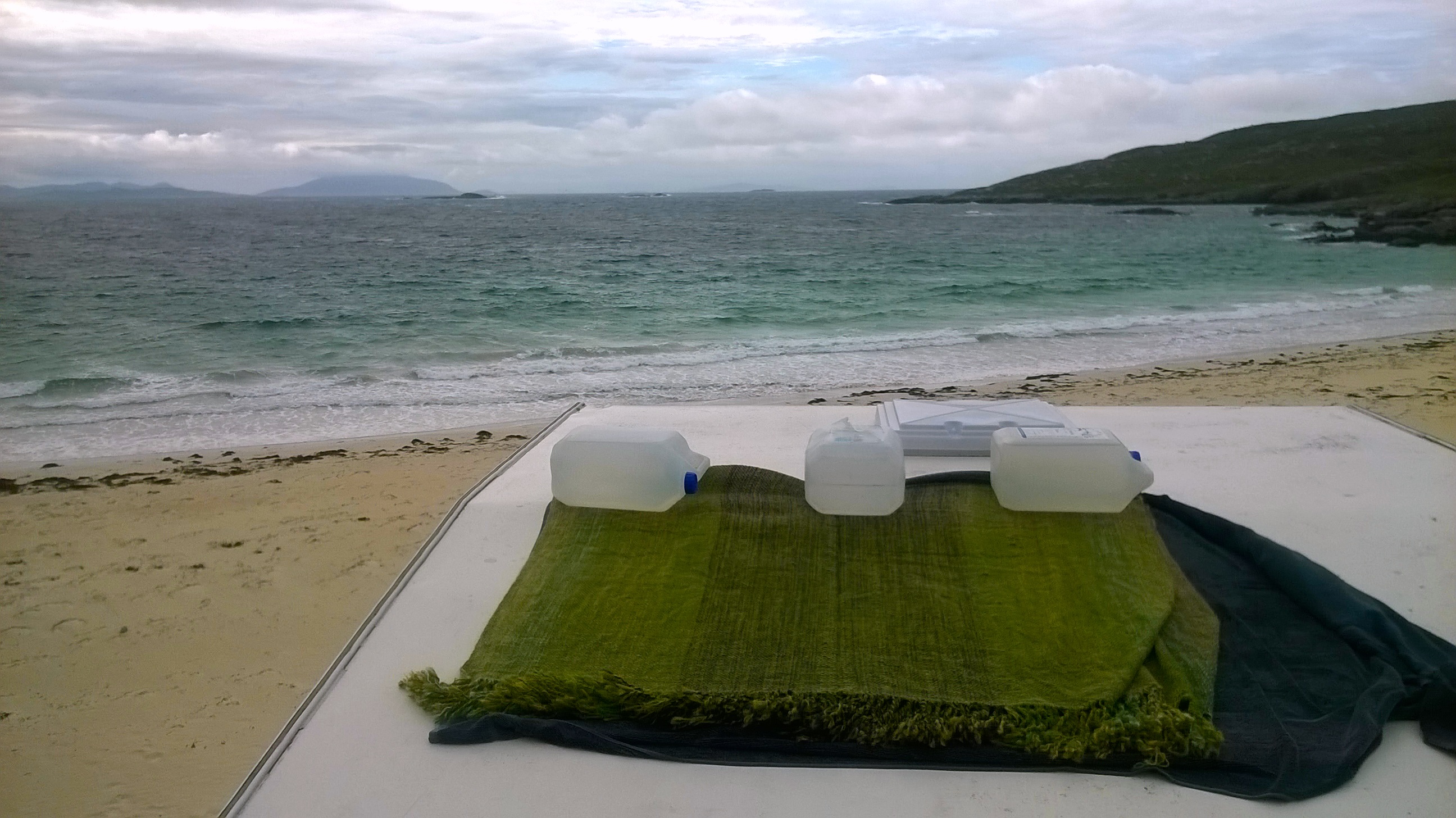
The weather breaks at Husinish just as I’m finishing my weaving. I wash it and spread it on the roof of the van to dry in a hurry – or so I hope: the gales are strong enough.

Drying blanket

I head back to Stornoway to dock in a campsite, crab it, catch the post and do my washing. This is all much more of a mission than it sounds, but, willing the gods to dry this wildy unco-operative Hebridean yarn, I achieve it, and by evening make my way to the folk club singaround. It is in a heavy-feeling pub, empty except for a few heavy-feeling characters and one friendly folkie. More folkies join us with guitars of various sorts. The first folkie, Don, is welcoming and exceedingly courteous, introducing me immediately to every new arrival.

The bunch of blokes are clearly excited to have a new young female in their ranks, and show off no end. They are less courteous among themselves, and the banter is sharp, but full of affection. A loud Glaswegian with beautiful bone structure, punky social justice songs, a foul mouth and a tender heart has told everyone to fuck off within the first five minutes (although it’s not my turn for a few hours, as I’m polite for a while). We have well-sung songs from Yorkshire mines; tongue twisters on Scottish distilleries; poetic ballads from a shy policeman; self-penned family love songs from an accomplished singer-songwriter; Americana and bluegrass from an Irish David; Dougie MacLean and clerical disgrace from a cheerful Peter; jigs from a dignified high whistle player; airs from a much-loved and harangued low-whistle player; Summertime from a deep-voiced mandolin player; and stories from another charming, skinny old sea dog with a finger missing, an eye twinkling, and a Harris tweed slung over his polo-necked shoulder. His forte and pianissimo tones beguile, and two of us accompany him with chords and melody as his tale breathes like swell.

As the turn comes inevitably around to me I writhe with performance anxiety, but then can hardly wait for my turn each time, until, happy at gone 1am, my small repertoire is exhausted. I drive back through town to the campsite wincing as I awaken the town with a screaming fan belt, and wondering as I pass a police van whether half a Guinness (yey again to my great, great, great grandfather importer!) has put me over the newly reduced Scottish limit. I ride the clutch as I approach in an attempt to quieten the fanbelt and our eyes meet but he doesn’t flag me down.

As ever I have loads to catch up on in town and am frantic. I’m due to head back south for the evening in case my visiting Devonian friend has any energy to meet up the evening of his arrival. Before I leave town I find a friendly mechanic-knight with hazel-flecked eyes that see into the other world and kind hands that fix my fan belt. Iain has the silky-soft inflections of an old, old Leodhaisach, like the voice that first enchanted me on Dartmoor as another warmhearted one leant on my gate one crystal clear New Years.

And then back down South to Harris. My friend, who will have travelled over 1600 miles to be here for just a weekend, is knackered and recludes. I take the Westerley road to Luskentyre as a platinum sun makes white light of the whole gulf’s sands. The cemetery car park at the end of the road is sunken in the dunes and dingy and grey, but there are holiday chalets, so I decide that I’ll feel safe enough to stay. I head through the dunes to the endless beach and look North and North West to Abhinnsuidhe Castle and Husinish where the wet green and silver crags catch occasional gold. I think to walk West and South along the firm sand of the intertidal zone, and walk and walk and walk but barely make it halfway around the point before concluding that it is too big to round before bedtime.

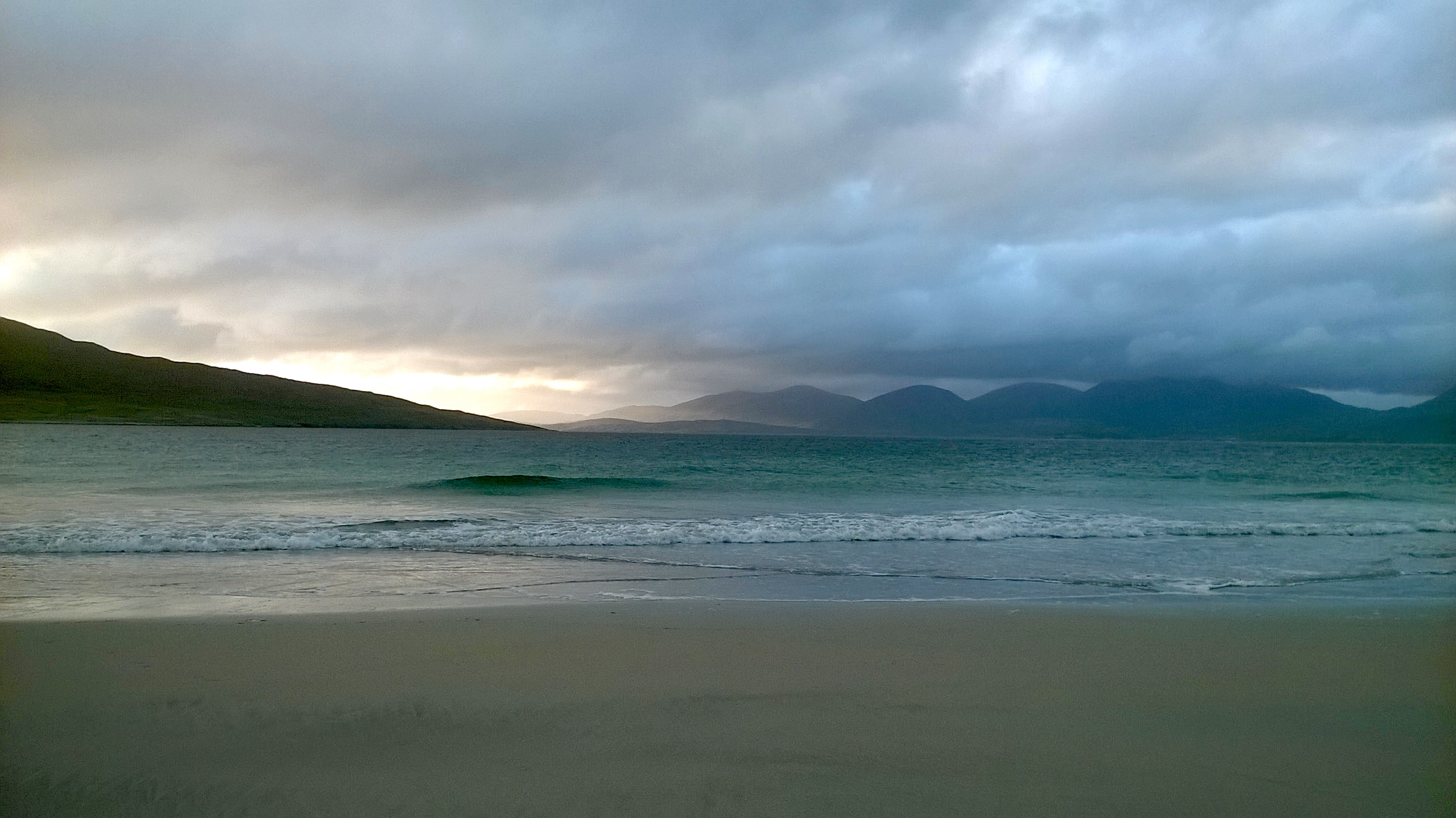
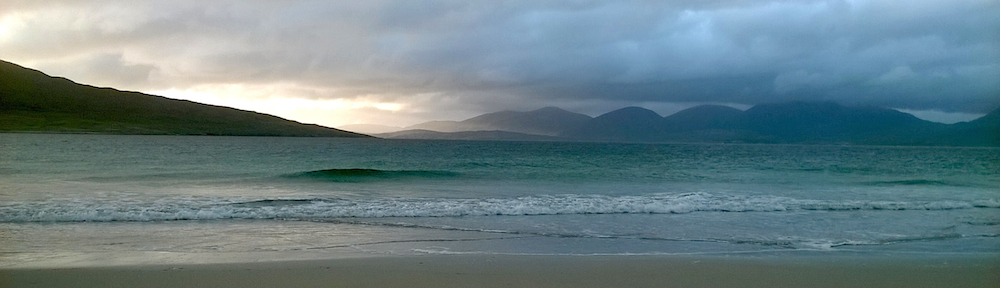
View from Luskentyre to Husinish

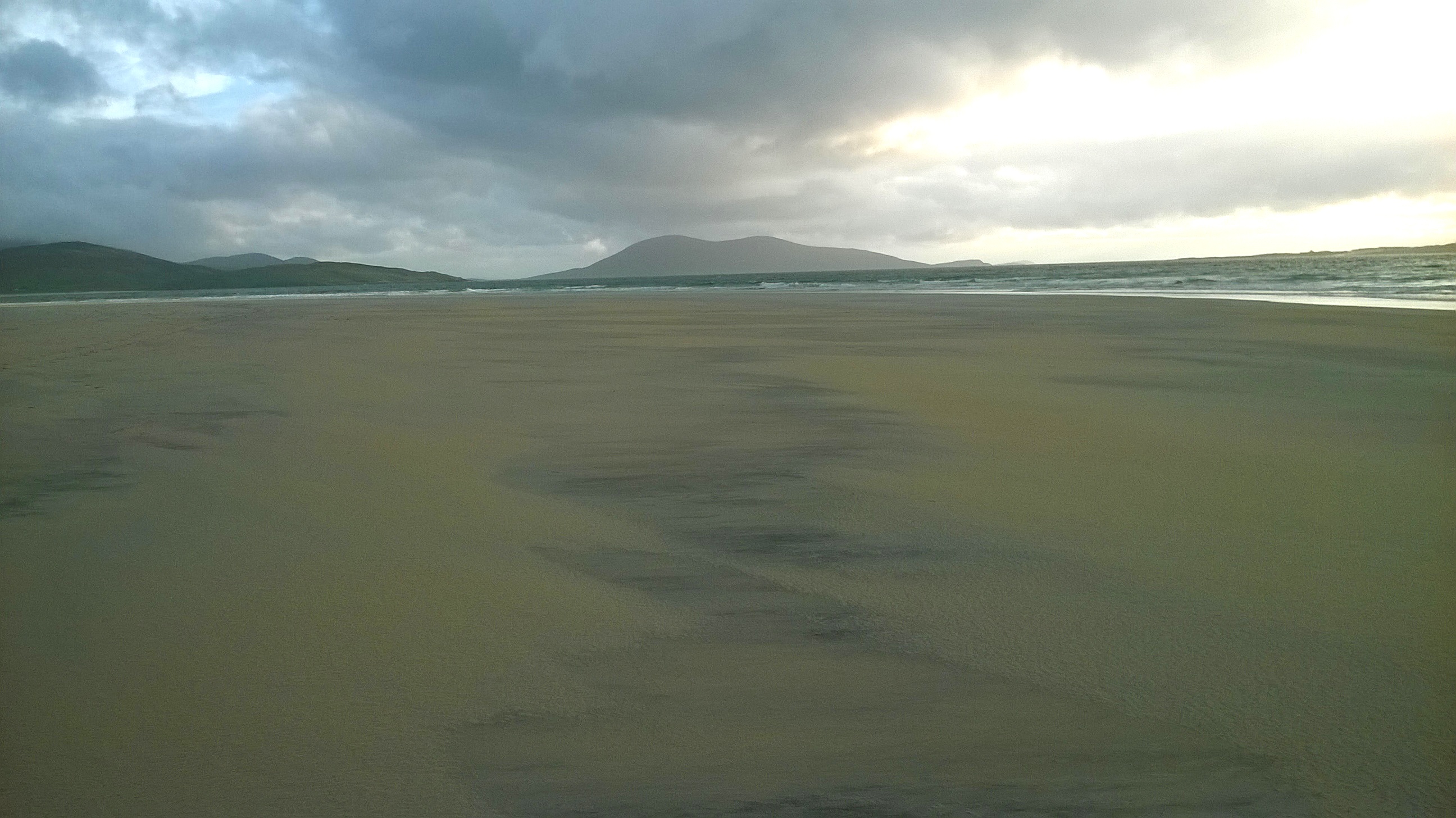
Luskentyre 2

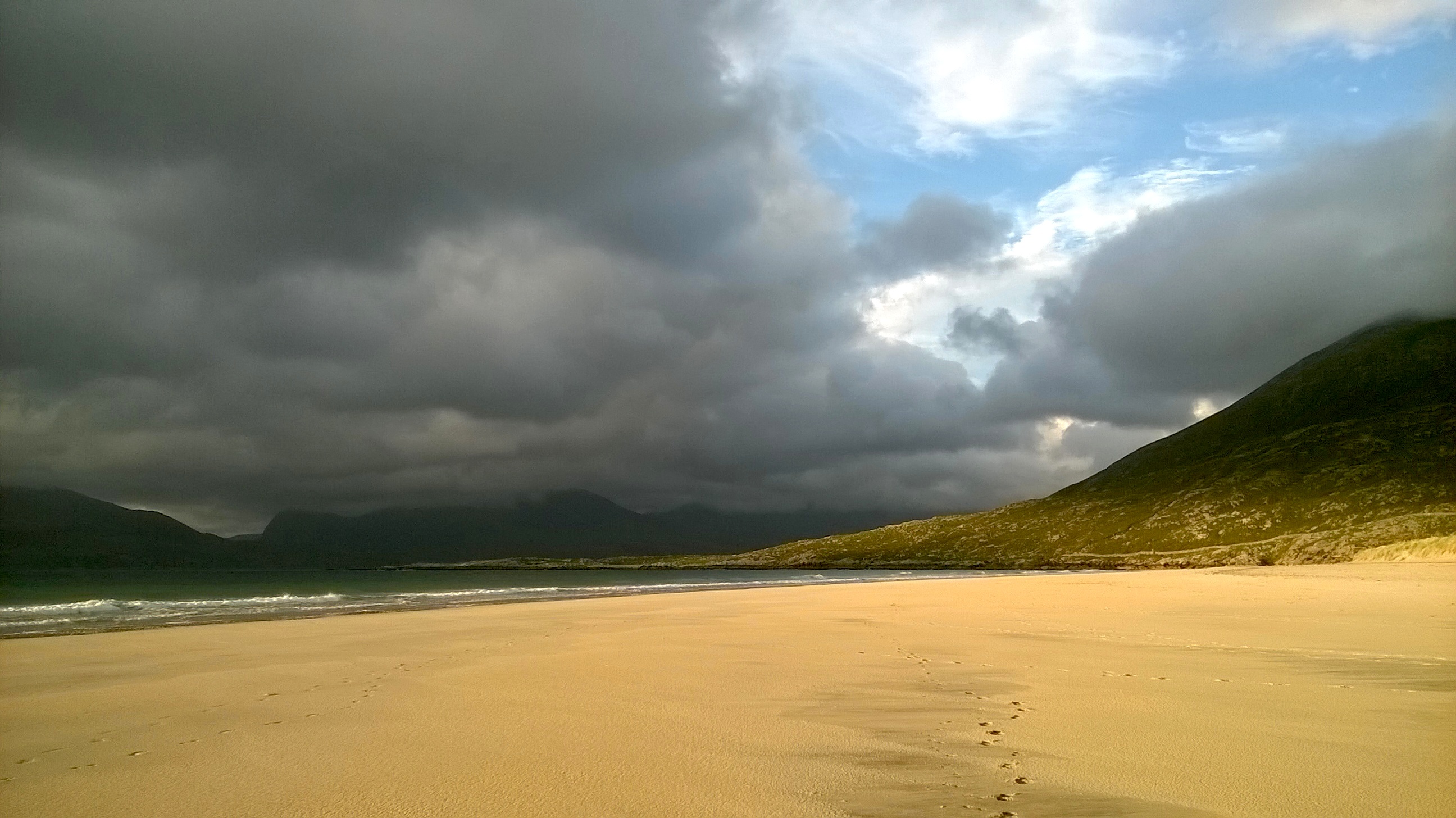
Luskentyre 1

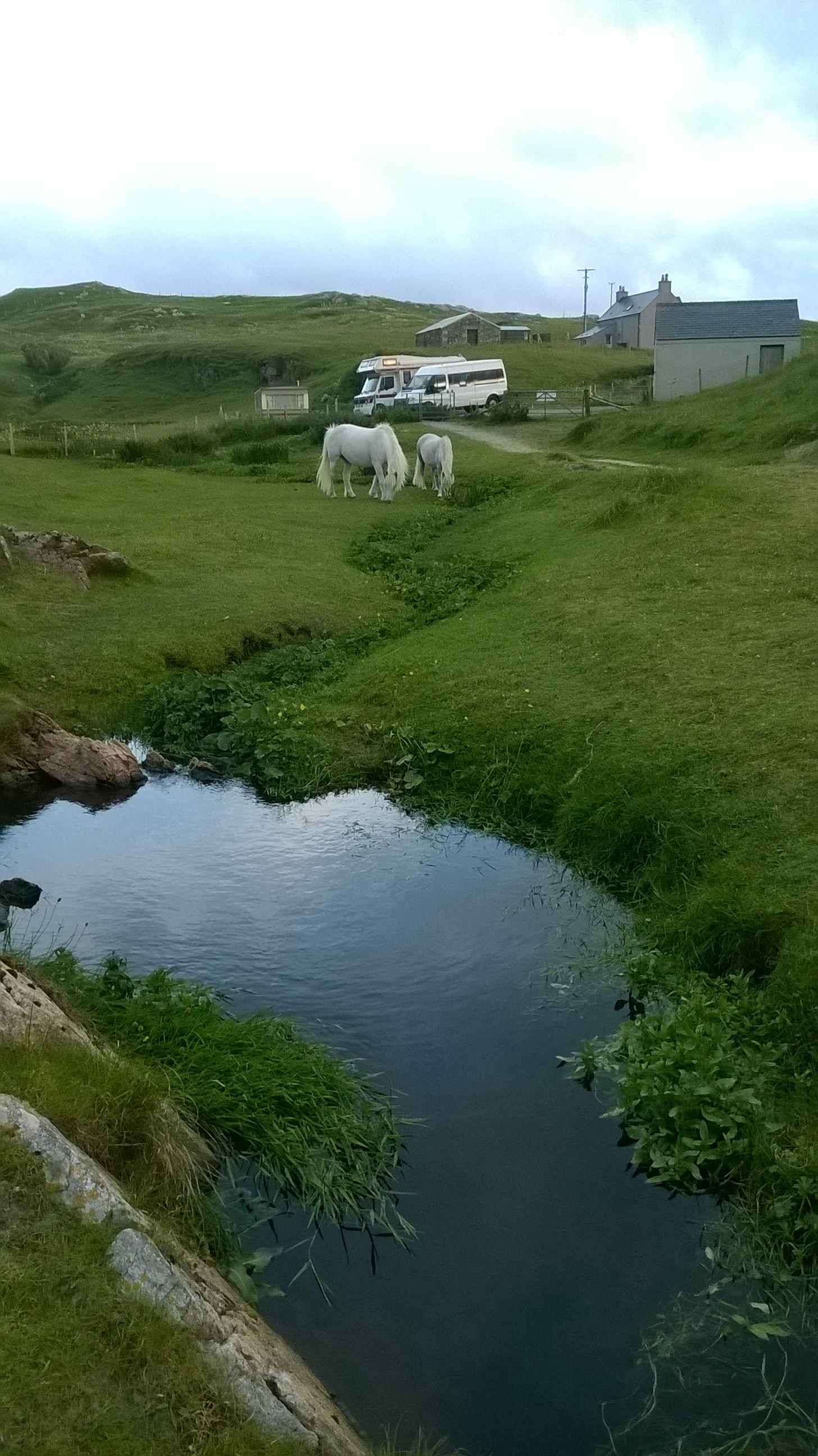
On returning to the not-entirely-friendly car park I meet two familiars near my van: white Highlandy ponies with all the curves and pride of my beautiful Spanish horse. I stick my nose in the thick mane of one and the horse-smell brings forth decades of tears for the greys I have loved and lost. If horses make a landscape look more beautiful, white horses make it magical.

White horses

The next morning my friend is game, and we explore West and South Harris in convoy in search of a music-making spot. My friend is even more particular about his music-making spot than I am about my parking-up spot, and it is amusing, and somewhat fruitless, though we get beautiful views, find a fantastic cafe, visit an Ionian church and get a good idea of the lie of the land. We return to a pull-in by still-platinum Luskentyre and practise some songs in the van (for the midge cloud is fearsome) in the evening sunlight.

My friend has escaped a loathed hot, summery, touristy Chagford and replaced it with this year’s only weekend of hot, summery, touristy Harris and Lewis. We do the tourist thing and go to Callanish. It is busy, but stunning nonetheless. Since I have my fill of solitude, I am learning to enjoy sharing such magical places with other awe-stricken people, especially the Down’s Syndrome boy who, mesmerised and mesmerisingly, does a gentle breakdance in the strong wind for ages.

I show my friend my favourite spots in Uig, and we find a new little beach – Caribbean, again – and I swim (briefly), and then we get out a notepad and compare understandings of musical modes. Back at the van an hour later in a rush before a supper booking, we snatch a try of this joyful Irish love song and are pleased.

The next day we head for Husinish, and I enjoy the rural-childhood-evoking sight of a big yellow library van. My friend goes on ahead but I don’t ever catch him up.

I am most of the way along the 14-mile track, a carful of Grecians waiting behind a cattle grid to let me pass, when without warning my clutch goes soft and I can’t get into gear. Local residents, they offer to help or drive me to my friend, and suggest I try getting into gear with the engine off. This works, and I go on my way a mile or two, and then stutter to a halt up a steep slope unable to get out of third gear. I’m in a passing place, but sticking out. I check the clutch fluid level – no problem. I try to force the gearstick – no chance. Oh well, most vehicles would get by. There aren’t many tractors here, but tractor drivers aren’t fainthearted, I’m sure they’ll manage with two wheels in the mud.

I walk to the top of the hill, thanking the universe that everything is in order because I’ve just met a Leodhaisach mechanic nice enough to ask if I can camp on his forecourt while he fixes my van again. Used to old vehicles, I have visualised this scenario months ahead, and also have AA cover. And everything really is in order, because not only do I have a friend nearby, but I also have a signal in this, the longest and most unruly road of the whole island.

So I’m on the rise of the road making phone calls when who should fail to squeeze by my van but the only vehicle on the whole of the island that couldn’t squeeze by: the larger-than-standard library van Sprinter, whose innards are lined with the weight of books from floor to ceiling, so that its nervous, non-native driver fears toppling if his wheels on one side go into the soft verge. He is stressed and I have to pull out all the stops of graciousness and persuasion, but since he has little choice, he kindly helps.

I have a serious rope on board – a thick, sailing sheet –  and we tie my van to his. We pause to let friendly locals by and after several false starts, tentative ineffectual tugs, and jumpy brakings on my part, he puts his foot down in reverse and heaves us backwards and we roll towards him and I manage to free the gearstick and manoeuvre into the passing place to let him by – and then thank Goodness that we are both in robust Mercedes with good torque and good brakes.

More of an islander than he thinks, he then invites me and hound aboard to give us a lift to the end of the road to find my friend, who has finally noticed than I am more than usually late and meets us on the rise.

Meantime my Stornoway mechanic has alerted the recovery company that they will get a call from the AA on my behalf, and wheels within wheels are moving fast on this little isle so that, in surely one of the most remote spots not just on this island but in the whole of the UK, Calum from Arnol Motors – cursing warmly that I am on the worst of all roads – arrives after my friend and I have had just one run-through of our new song. My friend leaves to catch his ferry.

Calum bleeds my clutch, and I agree to the ‘exciting driving’ that my Devon mechanic has advised against, because on the back of a recovery truck I would not fit under the castle arch down the road. So it’s fourteen miles in second gear, with Calum a safe distance ahead (in case I have an engine-in-drive-in-conflict-with-brakes moment) ensuring that all oncoming vehicles pull in to let me by so that I don’t have to change. The clutch goes soft again pretty quickly. I only hold up one follower, and manage to nip into a gravelly pull in and out again without stopping while he, frustrated and on the ball, zooms past. We pass a sheep who has his horns stuck in a gate and I wonder how I can communicate this at the nearby croft house without stopping, and fail to.

At the main road, Calum bleeds my clutch again, which holds pressure for a few miles up the hugest hill of North Harris, and then I stay in fourth all the way to Iain’s in Stornoway, and no-one is hurt.

And for four days I camp in the carpark of surely the only Malaysian takeaway in all the Western Isles. The manager puts his hand on my shoulder and grins and gesticulates ‘one night, one pound!’ and I buy a meal instead. Murph and I say good morning to Iain every day, who loves him. We bike to the point through the castle woods, and I use the library internet and do my usual in-town thing, even shyly joining in a trad session with talented young beautifuls in the arts centre. I marvel at how, spoilt for silence and beauty, I manage to make myself at home here in this car park jammed in my bus between a roundabout, a Novotel, an old dairy, a garage and the takeaway, but I do.

Lews Castle and Cuddy Point Stornoway harbour

I love this island.

Snow-lit hedgerow weavery and St. Kildan Selkies

Tomorrow is beautiful. I’m awake early and hit the road in the watery sun. I’ve bought an FM modulator which enables Spotify to play on my phone through the van’s surround speakers. This brings great excitement, though considering that Spotify is the last expense I ever slash even when I can barely afford to eat, it is ironic that yet again I have another complicated, poor quality musical set-up, cobbled together with a tangle of cableage and floating cigarette lighters (plural). But the result is better than I’ve yet had in any vehicle, so there’s progress, and the windscreen-defying scarps of North Harris and views down the sea lochs to the Minch are commanding.

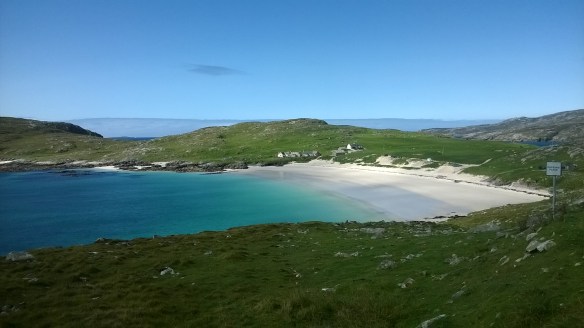
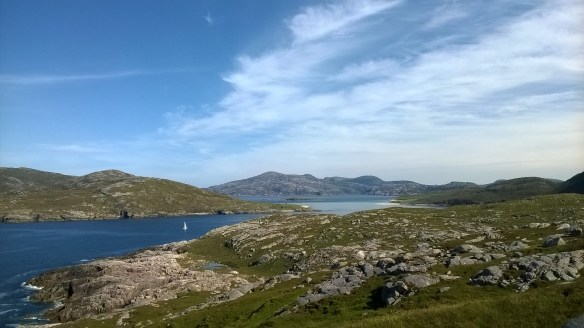
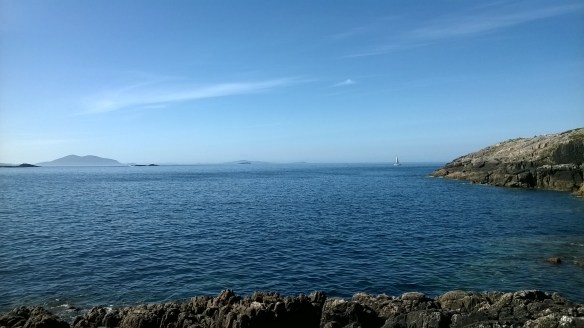
I’m heading for Husinish, the far north west of Harris, because two have told me about the castle lane and I’ve seen a parking spot through binoculars. Also because it almost meets with one of my favourite spots in the far south west of Lewis, though you’d have to go by crow, as both land and sea are impassable to all but the bravest veterans. None have told me about the perfect arc of white sand on the south shore at the end of the road though, and rounding the last corner the bay makes me gasp on this bright blue day. The best parking spot has been left for me, and I tuck the van into the middle of the dunes on a white promontory that leaves us almost on the beach, but perched atop a vantage point, and still nestled from the wind. We’re facing south to the waist of Harris, Taransay, West Harris and North Uist, with islets and reefs in between. And the indescribable blues enshrine us.

Yesterday I committed to a childhood friend to try and weave a blanket and get it back to Devon for her best friend’s wedding this Saturday coming. This is even more ambitious than I realised, as these troublesome Celtic yarns tangle and will not succumb. Although the machair flowers are yellow and purple and beautiful, I am surrounded by the white light of a snowed-in Dartmoor holding (as I remember it one rare Narnia Christmas) and the sapphire of a clear sea day and hatching designs for Hebridean coastal woves. However I must focus on the greens: when the Dartmoor hedgerows burst to life with bluebells, campions, beech leaves, stitchwort and ferns, I stocked up on those colours, and this has allowed me to say yes to my friend. I know I must work solidly for three or four days and evenings, especially as I lose time to tiredness the first day (not meant to work on the Sabbath here anyhoo, I’d be lynched!) and to a calculation mistake the second. (Said friend went into accountancy. She didn’t know me in my maths heyday when I peaked aged 15 and was top of the top set, and may not believe me since nowadays I struggle to even count or remember to double or halve a number when I need to.) I work later into the evenings thanks to the snow-light, and then on the third day, I lose time to something altogether more worthy.

In the morning the beach is confettied with jellyfish. The wind has stilled, the blue has stayed and the sea has warmed. Murph and I walk a circuit of the point – I haven’t been to the end of the road until I’ve been all the way to the edge, after all. We chat to the crofter on the way back. Yes, he says, some of those jellies are stingers. But I am hot and the sea looks Caribbean and I swim and it is amazing. And then I spot a purple stinger and turn tail in a flustered hurry and my stroke probably becomes an undignified doggy paddle, my head always lemmingishly high out of the water at the best of times.

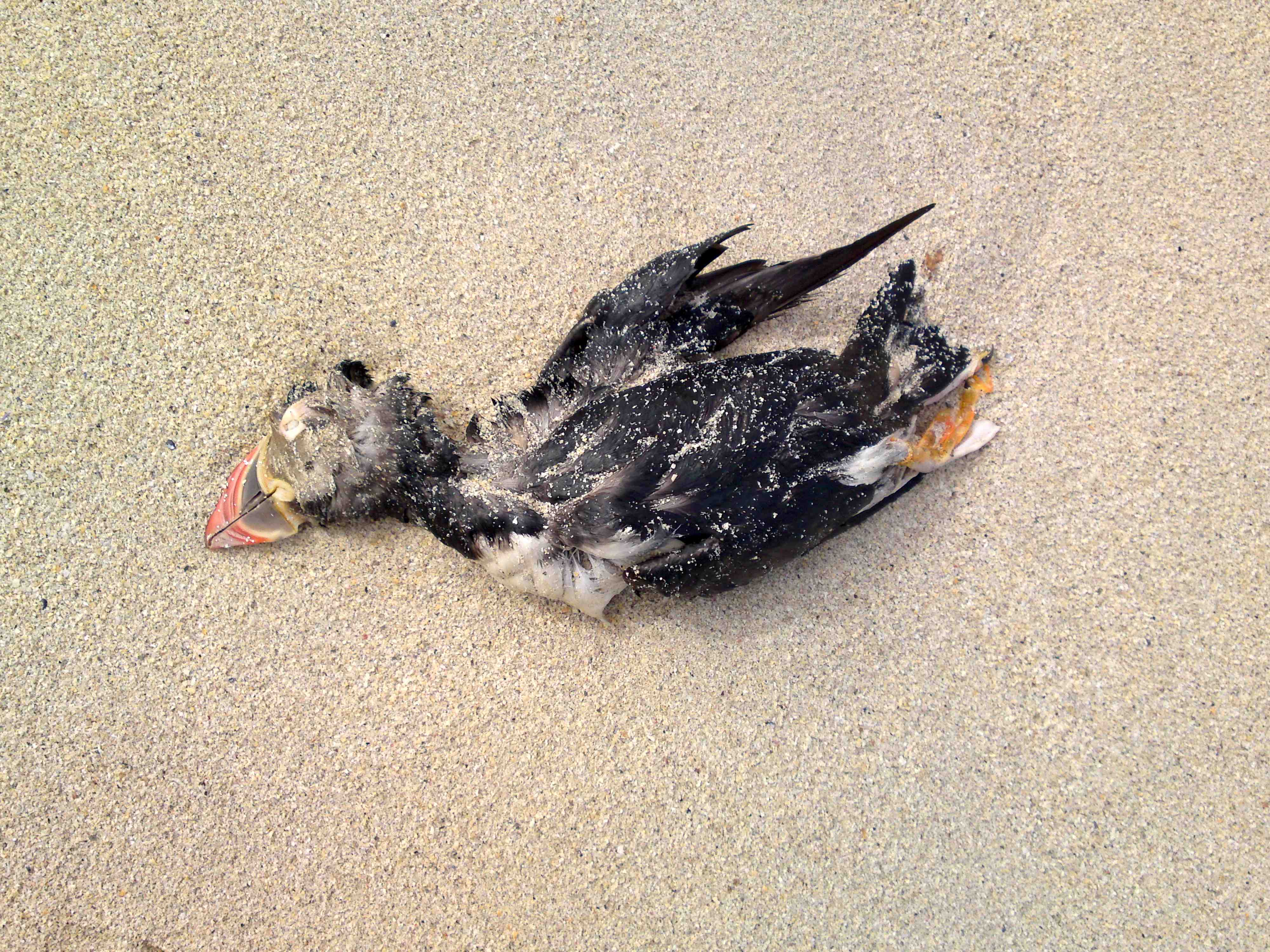
Among the stranded jellyfish is a dead puffin. My first ever sighting, a littley, very sad.

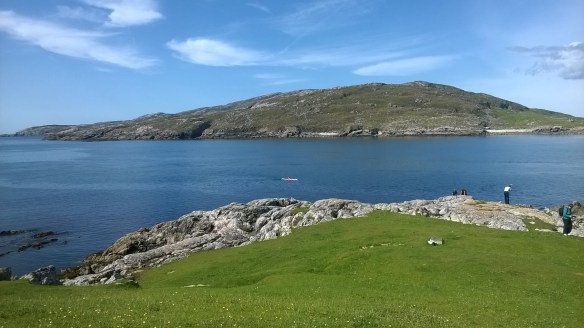
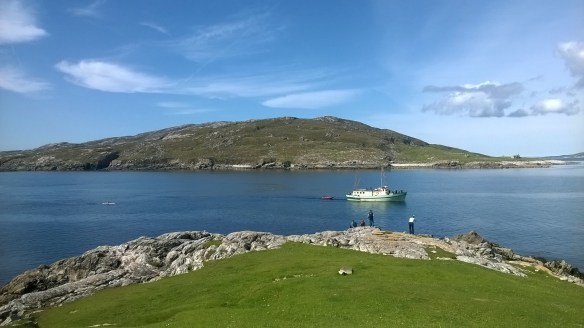
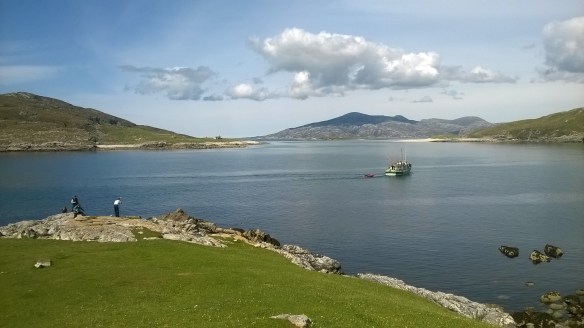
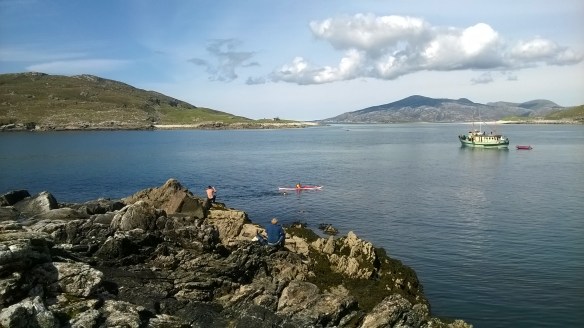
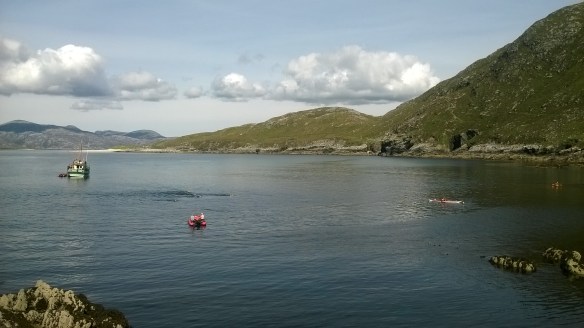
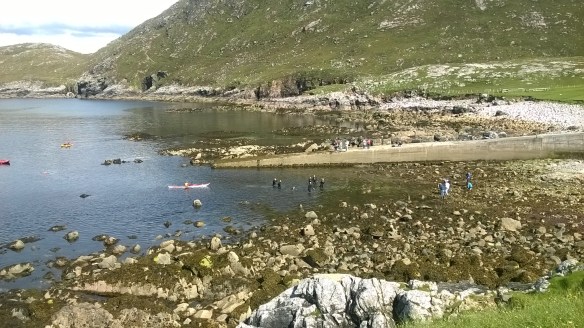
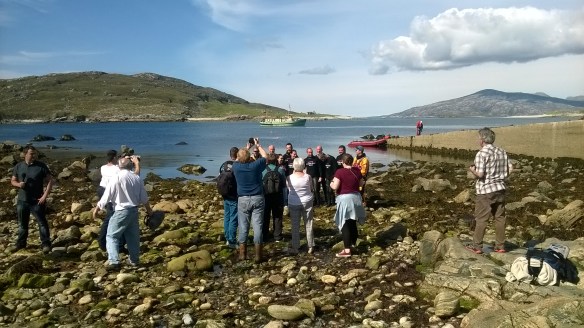
I pad back to the van in my wet-dress-competition outfit and by swishes a 4×4 with a satellite dish and camera on the top. Google Street View just got me, dressed like this – here?! A van squeezes into the little gap beside mine. This would normally annoy me but the woman looks nice. She looks out to sea searchingly, looks around, makes tea, looks some more. ‘Cooey’ she calls (or a Scottish equivalent) to someone down on the beach, and ‘Oh, there you are!’ when I appear in my doorway. There’s a car behind me. ‘Can they block you in? We’re waiting for a boat!’ This would normally annoy me even more had she not asked – my escape route has to be clear at all times, I’m that sort of person – but the people in the open-topped Mini look warm and we exchange a wave, and I am curious about the boat. There was one that came into sight earlier, but not many would be passing, let alone docking, in these waters, even on such a heavenly day as this. They’re waiting for a team of swimmers to come in from St. Kilda, which is some 60 miles, to the English/French Channel’s 20 odd. More cars arrive – excited parents. A warm Glaswegian woman, Catherine, rests her hand on my shoulder. Her husband Duncan is a Leodhaisach. I greet people, get back to the loom, go to my door and join the conversation, get back to the loom, offer kit that they haven’t brought when I overhear requests, get back to the loom. There is some backing and forthing as they prepare banners and charity collection buckets and picnics and check trackers and mobiles and – will they land on the beach or on the north shore? How far away are they? How are they doing? Who’s in the water now? Can you see the support boat yet? Gosh aren’t we relieved that they’ve made it! I am almost as excited as they are. This is the fourth attempt – others have been thwarted by seal-tossing killer whales, gales and tides. They are nearly here. Everybody goes to the north shore and I stay at the loom, diligently thinking of my promise, but then grab my bike and charge over the machair with Catherine and Duncan who’ve collected the forgotten banner. We fear we’ll miss the landing, but we don’t. We join the little party on the grass facing the isle of Scarp and cheer the boat and the kayakers and the swimmer. The press are there – the 4×4 with the dish are broadcasting live – and there are bottles of champagne and whisky and rum. Catherine and Duncan’s son is the ringleader, and Duncan is just utterly relieved that they have all made it alive. How proud he must be, and though it is nothing to do with me, I am moved, alternately wooping and welling up (for which Duncan gives me a gratitudinous hug when we later say goodbye). The other swimmers dive off the support vessel and they all swim to shore together, and the big man of the final heat thrusts his fist in the air and a tired but triumphant ‘Yabba dabba dooo’ fills the hills of North Harris. A new world record has been set by these very human immortals. I watch as they drink and cheer and pose for photos and hug each other and their families. Murph mooches about and makes friends, and the old sea-dog skipper of the boat comments on my seal. It is an honour to talk to him and his crew and a kayaker and a swimmer, see photos of the dolphins and minky whale they swam with near St. Kilda, and chatter to Duncan and Catherine and lead-swimmer Colin’s wife Donna. They joke about family seal blubber and happen to mention a tendency to breathe for only one minute in six, and I think that I have met a selky family.

The St. Kilda Swim raised money for local charities. You can donate or follow them (there will be another big swim I think) here and here. 

Stornoway stowaway

My sadness at the passing of new friends through the surf community is abated a little by the arrival of three great guys about my age who set up a fantastic camp and invite me to a lunch of their own caught mackerel (if I bring my smoker bag). It doesn’t happen, perhaps because I’ve warned them about fishing off the rocks when this sea is anything but mirror-like: I leave and pass them fishing in a loch inland some hours later. The succession of friendly folk is comforting nonetheless.

Hitting Stornoway, this down to earth, provincial, cosmopolitan, humble, proud little port town with its pretty boats and rough edges, is always a whirlwind of finding out, leafy bike rides, friendly encounters, stockpiling, WiFried over-lit sleep and internet intentness. People think that nothing ever happens here, but it does. It is 4pm on a hot, sunny afternoon, and I am cycling to the post office to be reprimanded for not having collected my parcels for ten days. Standing on my pedals up a steep side street and squinting into the abnormal light in the sky I see that the man in front of me is not only a heavy looking drunk, but a heavy looking drunk with a grossly bloody, freshly gashed, face. He looks like he has been bottled, and I wince all over. Luckily he has a kind-looking friend taking care of him, and they go on their slightly stumbling way. I am shocked. The clean, sweet, polite and friendly young guy I tell in the arts centre cannot believe it either. Stornoway is no Dartmoor village: Stornoway is like a little tiny Plymouth or a little tiny Glasgow, with a good dose of Looe and a little tiny Edinburgh thrown in – and all its own.

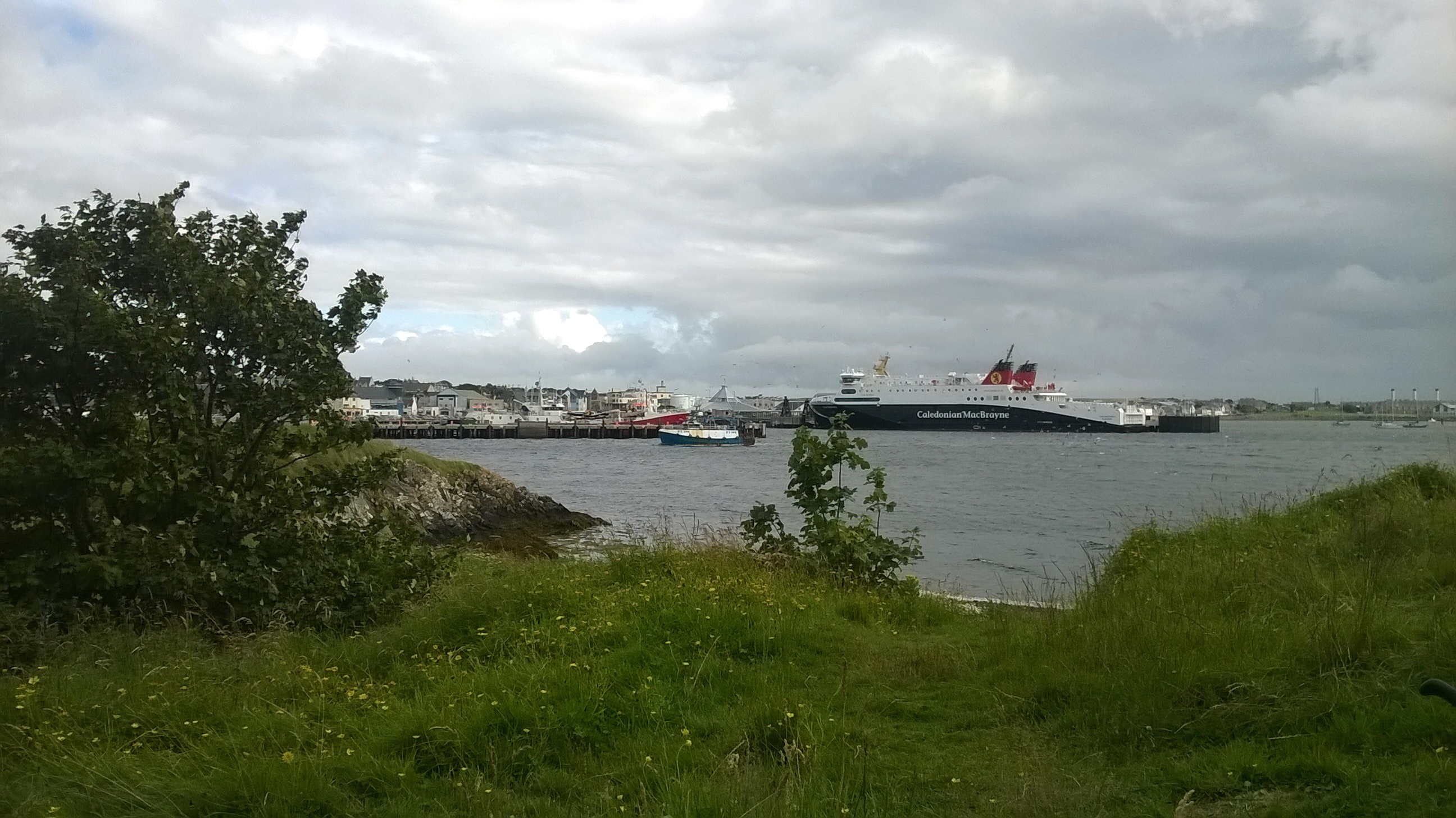
Stornoway harbour

Stornoway harbour

I’ve timed my visit to coincide with an open mic in an Irish pub (of course! There is nowhere they do not get!) which, so I’m told, often hosts trad musicians. However it is 10pm before anything happens, and when it does it is loud and indie. They also turned Murphy away. At least they have some Abhainn Dearg, but after that I leave without waiting long. Also at least there were some Gaelic speakers who were able to confirm that a mystery Hindero Horo sung by an Irishwoman, is not Slavonic, as some have suggested, but indeed Gaelic, of some sort.

Friday nights are trad nights in the Retirement Centre. I have followed so many great musical leads: dear friend Hannah Fisher and boyfriend Sorren MacLean and father Gordon MacLean of An Tobar fame, and how they drew me into the pub with Karen Matheson’s bassist, Eamonn Coyne and the Treacherous Orchestra in a session, and Calum the local musician, and their mate Dougie MacLean my other friend’s neighbour, and this weekly class and that weekly class and this weekly session and that weekly session and none of the leads have gone anywhere thus far. I haven’t done enough playing or singing alone, and none with others. So now I am visiting the Retirement Centre at 6pm for my Friday night. I call in early as fliers say contradictory times, and meet a couple of oldies who welcome Murph. ‘We’ve all got cancer’ says one, cheerfully – a cancer support group member. ‘Well, you look well on it’ I say, and we grin, warm, and talk about deerhounds. And not long after 6pm two men are comparing chords and some lovely Donovan fingerpicking reassures me that I’m in the right place. (I try to overlook the synthesiser and the electric guitar, the latter played by a bejewelled and mulleted dark haired man in black with a white ruffle blouse and black and white pointy shoes. His name, I think, is Gary and I wonder when the glitter will come out.) Not liking me to sit by myself, folk draw me into the front row, and admitting I like to sing, I pick out some of my favourites from th songbook of a gutarist called Alan and have a quick rehearsal. Of course the rehearsal goes better than the performance, but the audience – old Leodhaisachs, young people with special needs, young Canadian nuns and some of their relatives – are appreciative as I give them some Irish Gaelic, Black is the Colour, Speed of the Sound of Loneliness and the locals give them some wartime waltzes, hornpipes and Americana. Alan sings a song written by a local friend, the true story of the three lighthouse men from the Flallan Isles off Gallan Head, where three untouched meals were discovered days later, all ready to eat, with no other trace of the disappeared men. As my friend would say, these are not the Doyles and the McGoldricks, but it is a sweet evening, and lovely to be a part of. I’m invited to sing at their monthly folk club next week, and I go back home full of song.

The mood lasts all the next day as I, in feverish creative mode – always a productive one – build this website in 24 hours, staying online in the Arts Centre till gone 10pm enjoying my Mac. Filled with energy I charge on my bike in the dark from little Co-op to big Co-op, do a late-night shop, and then refuel the van and stock up with a fine selection of luxury and organic chocolate bars from the garage. (Stornoway rocks.) I’m about to head down to Harris and didn’t want to leave for unknown territory at nearly midnight, but I am getting brave, and do. It seems a shame to drive through new country in the dark however, so I resolve not to go far, although the garage staff tell me that there’s nowhere to camp between here and the beaches of South Harris, which a good few hours away in my (much admired, you know) brickmobile. I’m heading down the east side of the island enjoying some tunes and turn off to take a long, ugly road out towards the coast. Every layby looks bleak, and every scattering of houses shuttered and unwelcoming, until I spot a Cornish-looking hobbity creek, and tuck myself in between the grassy tumps twixt houses and a pretty slipway, and sleep contented in my strange little world, thanking my nose for a good place. Hitting Stornoway is also always a bridge between one adventure in a stunning wild spot and the next, and I know that tomorrow will be beautiful, wherever I land.

North West Lewisian coastal communities

Satisfied after a good day’s vocational exploration, I head to the surfing beach as recommended. Busier than spots I’d previously sought, it is friendly and welcoming, and I find the Cairngormers and Gareth the nearly-Welshman in the hoody, both of whom were at ‘my’ beach a few days ago. Now Gareth is with another lovely guy, a gorgeous German called Sebastian who directs all his conversation at me, and we sip wine and chatter, joined by lovely Belgian Olivia and Yves and feisty French terrier Odette who demands love from Murphy every minute. I walk and weave and watch them surf. The sea gets big and looks terrifying. The Cairngorm girls bring me mackerel caught by their dad Mark, and I smoke it and it tastes delicious. Norman the Hattersley weaver visits the beach and we are surprised to see each other. ‘Is that yourself?’ he lilts, and gives me a kiss on the cheek. ‘And I thought I’d never see you again!’ It’s nice to know a few locals – anchor points, safe harbours. I stay for a few days, feeling cosy and enjoying our transient community.

I leave for a night and head to the northernmost point of Lewis, and Yves, Olivia and Odette appear there too. I walk both the dogs, spot fulmar chicks in the grassy cliffs, eat crab, go online, and watch the quiet harbour.

Port of Ness harbour colours

Port of Ness harbour

Port of Ness

Fulmar chicks

Feisty little French tart

On Port beach

Murphy doing the Spanish horse thing

Murphy and Odette

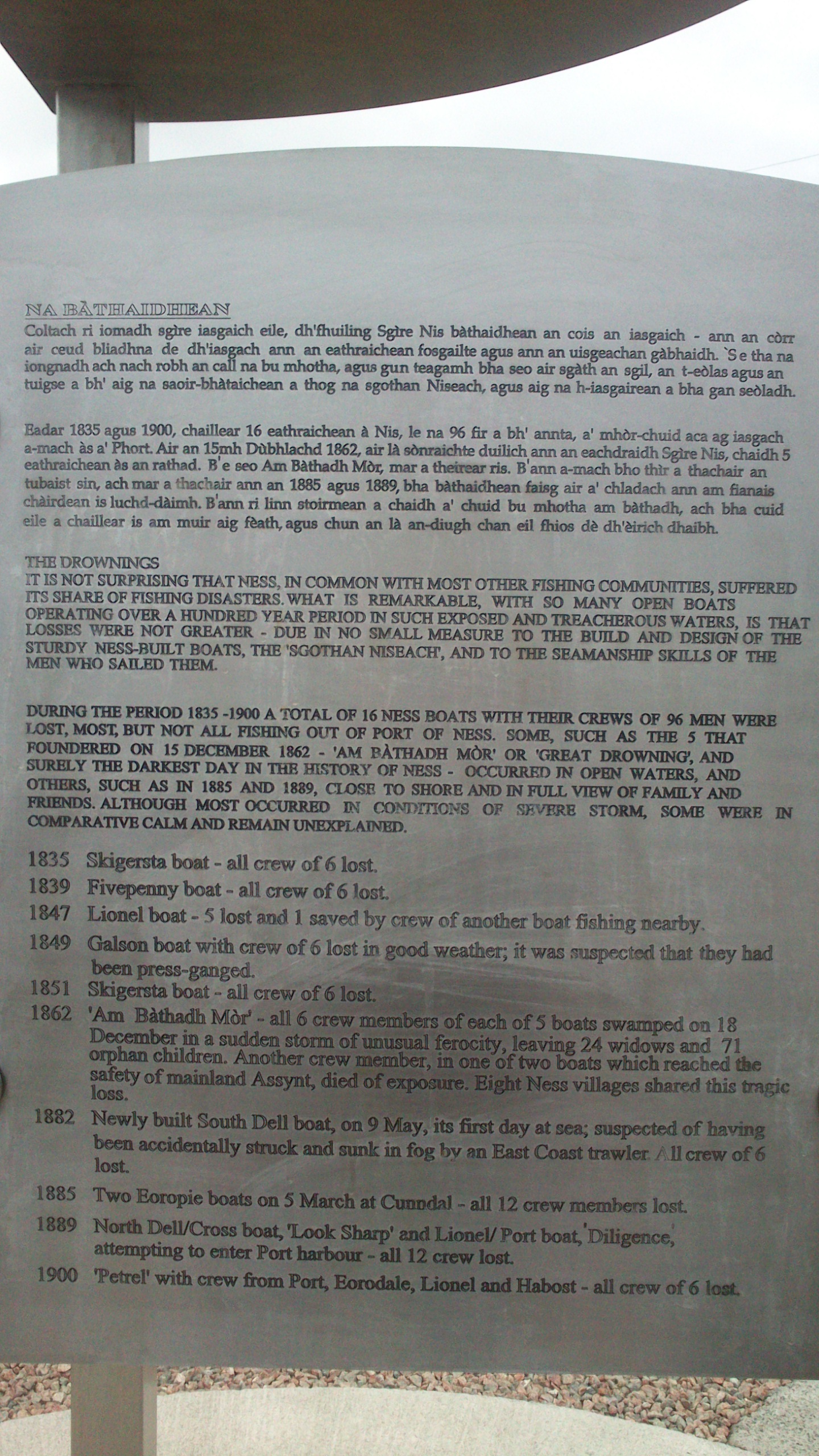
There is a fishing memorial, and the list of names and dates of stricken boats is moving.

Ness fishing memorial

I meet a Mr. Tumnus type with a beard and piercing blue eyes. I flag him down because he is driving an old Merc the like of which I’ve never seen: a Mog, apparently, with a crane on the back. We talk about engines. He is alternative and evidence of a scene. It turns out that his partner is the talented designer whose rugged but highly tailored and lithely-lined work – kilts, aprons, cuffs, belts – I admired at the festival. This quiet little harbour sprawl has some life behind its grey concrete walls.

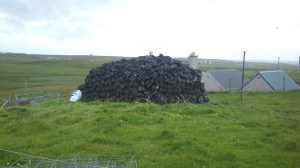
Thou must not covet thy neighbour's peat stack...

Thou must not covet thy neighbour’s peat stack

On my way back down the coast a brief signal spot delivers me several messages from the Stornoway police who have been advised to take my telephoned complaint about the shooting incident seriously, so they send a van out from town to meet me in a car park I’m passing. I give them a detailed account. They take random notes and are interrupted several times by something on their radio that sounds briefly as if it is more exciting, but then disappoints them. We conclude that it was a more serious weapon than an air rifle given the distance it covered, but they think it was accidental. I think they are wrong and that they’re missing significant details in capturing my statement, but never mind. I guess they’ll listen better to the next person who reports it. I have a tummy ache for hours high up in my gut and I’m not sure whether it is the bleakness of inattentive policemen in a concrete car park, the crab, or the fermenting peas I ate earlier. (Must fix my fridge.)

I return to the surf beach and rejoin the comforting little community for another few happy days, sharing anecdotes, perspectives, languages, beer, potatoes, flapjack, chocolates and a Scotch single malt with an English name. I’m sad as one by one they all leave. I leave too, docking for a night in civilisation where I need hook-up to iron all the woves I’ve made, and then come back here, resting up before I muster the energy to hit Stornoway for a couple of marketing days online and a couple of musical evenings. After that I will start the next chapter: Harris.

Weaving in the Blackhouse

DSC_1315

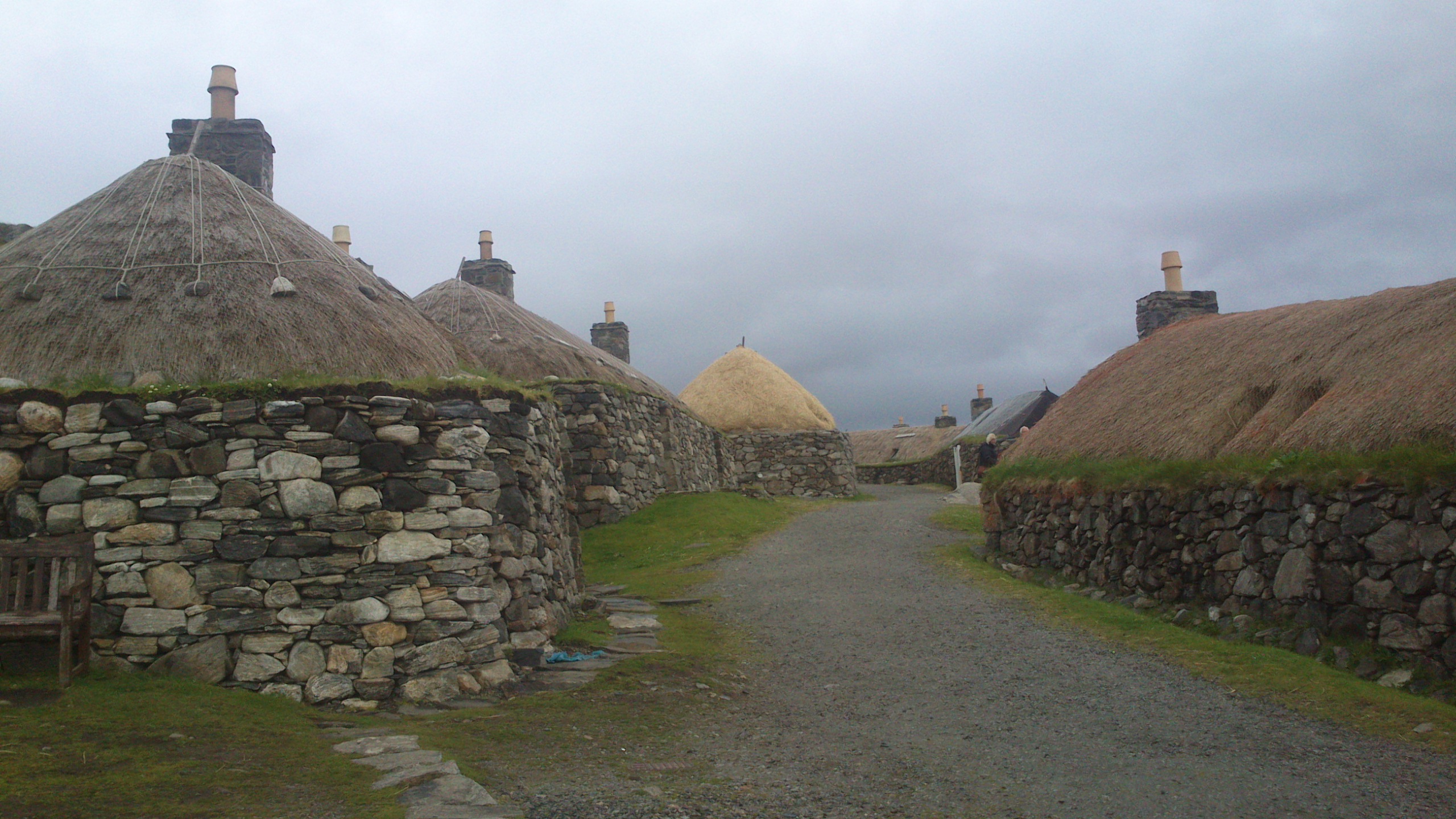
Buoyed up with inspiration and bowed down with a sackful of tweed bobbins over my shoulder from the mill, I get back in the van and head on out along the coast road to Garrenin, the blackhouse village. I buy a ticket for the museum and would like to linger in the shop and cafe (my fridge is empty) but I go straight to the weaver – also on an old Hattersley – and pounce, and cannot leave. He is tying the ‘weaver’s knot’: tying in the new warp to that of the outgoing cloth. Now that might not sound all that exciting but there has been a build up to this: my Glasgow friends admired the agility of his fingers as he knotted with great speed. I asked if they were sure that he wasn’t twisting the yarns together as I’d seen them twist it in the Ardalanish Mill on Mull. No, they were sure that he was knotting. And so that I happen upon him at just this stage in the process is a stroke of luck. He is leaning over in the authentically dim light and as other visitors and I crowd in to see we block his limited light and he can see even less. I say that I’m really keen to learn this speedy knotting technique and he gruffly asks me to hold the crossed warp threads a moment. This is an honour indeed, as though he is there to demonstrate to the public, he is weaving an actual tweed for the mill, and if I drop these ends, he is in trouble. He gets a magnetic LED light and sticks it to the underside of the ‘castle’. He takes back the threads, and his left hand holds the ends, whilst his right ties the knots, no left fingers involved at all. He can tie 540 knots in 35 minutes. He shows me the technique, offers an old cloth-end for me to practice on, and as his apprentice takes over I challenge him to a race. We don’t stop nattering, and as the apprentice is on knot 12 I am still only half way through my first knot. I get my fingers in the wrong place endlessly and can’t believe my clumsiness, but enjoy learning about weaving and the state of the market, the culture of crofting, the changes and challenges, and they invite me to take home my cloth-end to practice on.

Who would imagine that a simple knot would absorb me for the whole afternoon. Hanging out with a loom is like hanging out in a beautiful place, or hanging out with a warm, cud-chewing mammal.

Carloway Mill

I feared that too-frequent and involuntary moving on would make this lifestyle a strain and even be the dealbreaker for me. I need the reassurance of routine and to know and feel part of a place, and it is wonderful to stop for a week and settle into a rhythm and become familiar. But if someone asked me what the highlights of it all are, one of them would certainly be getting into the driver’s seat and heading off to a new place for the next adventure, wind blowing, van rocking, Murph peering, my eyes scouring, (probably Irish) music singing.

I take a side lane to the blackhouse village and by chance this takes me right past the entrance to the mill. As I pull up I greet a man with a Harris hawk on his hand. I’m glad that I recognise her and he is proud that he bred her. I ask whether she feeds him and he says yes, and I admit ruefully that my hound doesn’t feed either of us. (I must remedy this. He tries for the rabbits but can’t seem to turn quickly enough at his great height – gladly he is cautious by the sheer high cliffs, which seem to be the rabbits’ favourite, perhaps for that very reason? I’m wondering whether to get a smaller whippety lurcher companion for him for the smaller prey, since sheep are not fair game.) This one is six years old, and may live to a grand old 25 or 30, compared to the eight to ten years’ life expectancy in the wilds (of South America, I think, rather than Harris, though I should double check this).

http://www.thecarlowaymill.com/

(Photo by Carloway Mill)

(Photo by Colin Smith, Geograph)

I’m lucky at the mill, who don’t run a schedule of tours and cannot entertain visitors in their busiest moments. This feels like a special occasion – going to meet the folk behind the Tweed of Harris – and I have dressed for it, in high boots, a dress I used to teach in, my own woven jacquard cape, pearl earrings and a high, less-hedgerow-than-usual hairdo. I know that power dressing can, sadly, make a difference in how seriously people take you. Take yourself seriously Eloise, you’re a proper weaver on Important Business today. The first person I encounter is the production manager, known as DK (below), friendly and helpful, like all the 15-odd staff I meet. The atmosphere is relaxed, people are cheerful and serious both at once, not too stressed, but concentrating. I don’t know what I was expecting, but it’s nice to see an ordinary yet interesting bunch, informal, polite to each other and quipping too, looking quite at home and looking like they’d be equally comfortable tillering fishing boats, working bars, down mines, driving milk floats, knitting baby blankets, designing clothes, making music or working crofts. I feel over-dressed, posh, and terribly English – like someone who’d wear pearl earrings and Harris Tweed. But maybe that helped.

The Carloway Mill is the smallest of the three Harris tweed mills, says their website – which outlines the multiple steps in the milling process: http://www.thecarlowaymill.com/how-harris-tweed-is-made.html   DK takes me on a labyrinthine journey through their many beautiful machines. It is fantastically, quintessentially steampunk, and I feel like I’m in a Hessian castle.

He shows me the dumpy bags with tons of fleece that has been washed and graded in Yorkshire where it is gathered from throughout the UK by the central Wool Marketing Board. All the fleece is bleached for consistency of colour.

Next we go to the dyeing vats – huge, aluminium(?) cylinders with pipes coming out of them, like the old copper whiskey stills used illegally in the hills, or (now) legally in the first distillery in the Outer Isles and the only one to use the most traditional methods and equipment. The weaving mill has machinery dating from 1906 – actual Industrial Revolution machines. If Saruman, Gandalf, Radagast, Alatar, Pallando, Dumbledore or the Wizard of Oz had factories for brewing spells in, this would be their equipment – all aluminium, steel, iron and wood.

A photo I’ve borrowed of DK at the dyeing vats, by Robin Mitchell

I have a particular thing about wooden pigeon holes or lab shelving. I somehow wrestled two huge units of these that my old university were selling off cheaply onto the roof of my car and up my stairs to my old textiles workshop at home. Then my neighbour helped me wrestle them back down the stairs – they’d grown even heavier, seemingly – to cut them up to furnish my van, and their satisfying subdivisions now hold all my wool (about 80 kilos after the Carloway visit, poor old van). The mill’s gorgeous wooden pigeon holes hold samples of fleece dyed in their 36(?) core colours, with names like ‘Rye’, ‘Straw’, and ‘Petrel’, because in this business people know their grasses and their birds.

DK takes me to the mixing corner, where another machine lurks and blows fleece through large, overhead pipes that look like air conditioning vents (how things change, and don’t!), into a room that reminds me of those washing-machine-drum fairground rides where the floor falls away from your feet while the centrifugal force pins you to the side. We go just inside the doorway and a tattooed worker grinningly imitates switching things on and I jump out again. He shows me the mixing recipe, handwritten on a notebook. Of 100 kilos of fleece, this colour is made up of 42 kilos of one green, 21 of another, 0.25 of another – such is the precision of the heathery blend that must make up this perfect yarn.

Next we see the old-but-still-very-much-working carding machine that sits beside a similar but computerised one: a huge thing the length of the room, like a carriage of a train, in Edward the Tank Engine green, complete with painted, glazed doors all the way along, and full of teeth, tines, rollers, cogs, belts and bicycle chains – or so it looks to me. So here the dyed, aerated, mixed and oiled fleece goes into one end and is finely blended into a more homogenous fluff before being stretched and rubbed into miles(?) of soft, delicate, drawn out strands. I pick up some blue from the floor and tease it in my hands as we walk, like a magpie with a treasure – a preciousss. The carding machine is about to be switched off, using a huge lever with numbers stamped into the steel (or is it iron?). Its operator wants me to see to the end of it before he does, and we prod the rotating reels of strands like he does to check for the density and firmness, which indicates consistency of gauge in the yarn-in-process. He heaves the lever from 10 down to 0 and says he feels like Frankenstein galvanising.

Next we see the spinning machine (but I don’t think it’s a Jenny?), and only the tiniest part of it inserts the twist in another warehouse-length row of reels and rods and rollers and bobbins. (One of my weaving students laughed when I said ‘bobbin’: we are talking about a huge 18 inch or so thing with a kilo of yarn on it.)

(photo by Juniper and Jane Textiles 2013)

We go to another warehouse to see the warpers, who are guiding very small handfuls of very long yarn in very precise order onto warping boards the size of warehouse walls and rotating drums and metal beams as heavy as ship’s beams with furled sails. The beam or the chain from the board will be delivered to the home workshops of the 150 or so weavers who work for the mills, and loaded onto their looms like cartridges, ready to weave a 50 or 90 or 250 metre tweed. A piece of paper attached to the beam tells the weaver the warp pattern they’ve been given and the order in which the weft yarns should be woven. (I am going to see another weaver this afternoon, and will fill in some of my gaps there.)

When the mill collects the woven tweed, the first thing they then do is mend it where the warp has snapped or the weft has looped: three or four women work with long darning needles, the cloth spread over table-like lightboxes or hung over them like tents against vertical lightboxes. A certain amount of time is allocated to this step, so if a weaver has left too many flaws, slowing them down he (or occasionally she) will be charged a penalty.

(photo by Elizabeth Martin Tweed)

DK and I chatter with one of the women as she works. She shows me the line of warp she’s working on. She wears glasses and I worry for her eyes but she says they are not strained and she doesn’t feel cross-eyed. We talk about the prestige of tweed, the Britishness and the Scottishness, the referendum and the company’s neutrality, the audience and the outlets. One of the mills has sold some lengths cheaply to Primark. I love that it could be a cloth for the people – as I understand it once was – but also understand the precariousness of brand and reputation. This is a cloth of integrity.

The finishing processes turn the coarse woollen weave into a smooth, refined material. After mending, the cloth is washed in what looks like a huge beer barrel with what look like tram wheels inside with brass rims that beat the cloth. This is the equivalent of the old ‘waulking’, though alas there are no brawny women singing the rhythms. Back to the final corner of the middle warehouse by the menders and DK shows me the huge, black tumble drier (my, inaccurate, nomenclature) that does nothing as random as tumbling and looks like an enormous, gothic sideboard (but is at least half the length of the room), and then the comparatively-small-but-still-enormous wooden and calico press rollers that steam iron the bolts. Sitting on the side of this machine is the gold for the crown: the certificates that declare the virgin wool, islander-woven, perfectly-finished quality of Harris Tweed, the name or number of the weaver, the mill, the certifier and a witness, and lastly DK shows me the jewels: the stamp every few yards on the cloth and the labels that the tailors can sew onto their garments to show that this is the Real McCoy as protected by an Act of Parliament: the only certified cloth in the world.

[I’d like to borrow all the photographs from this site, but the blog is beautiful, so just visit that: http://www.harristweed.org/blog/ ]

The mills need more weavers, having about an eighth of the numbers they had in the 1960s boom in the face of continuously increasing demand. I ask about how the weavers are paid, how they acquire their looms, what the work pressure is like, how much autonomy they have. Just building an idea of what a Hebridean weaving life could be like…