Rerooting

Extreme electrosensitivity makes most jobs impossible and has led me on a poetic, eventful, exhausting, seven year journey to find a home, researching and developing sustainable livelihood all the way. Now at last I’ve found somewhere I could live, work and be well. But it’s a daunting undertaking

The Business

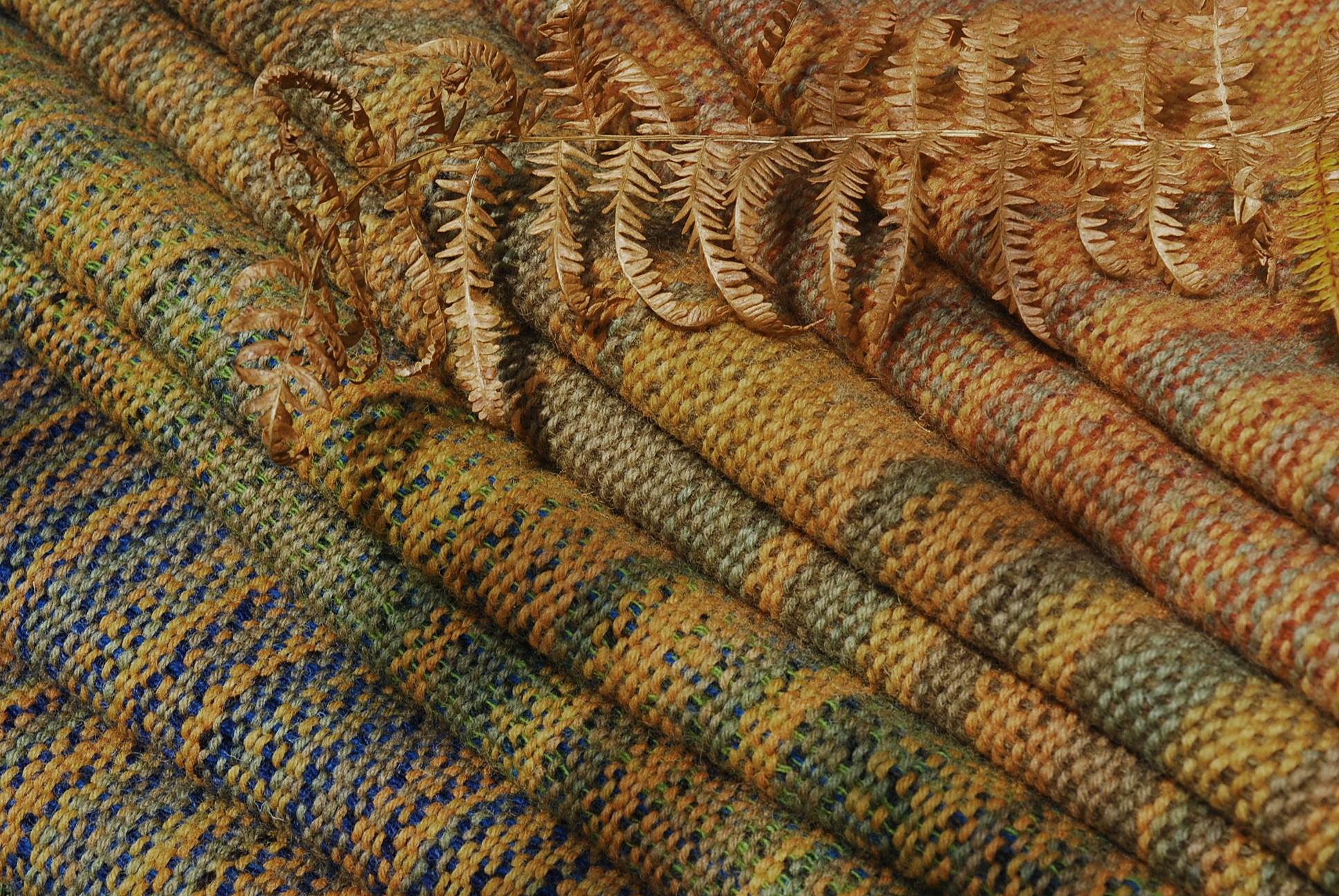
I have woven £12,000 worth of stock these last two seasons. This is not big news, the big news comes at the end of this piece. But it is quite good going for a van-based craft business in a period of even-more-upheaval-than-usual. My new wares are in my shop now, and there will be much more to come through autumn and winter – ponchos and shawls followed by the more strictly wintry warms, the snugs and scarves.
Now, unfortunately that does not mean that I could, with my current super-slow methods and tiny, itinerant workshop, weave £24,000 worth of stock in a year, because in these two seasons I have done next to no blogging, marketing, listing or, dammit, selling, which together require at least a third of my effort over a year. And it also doesn’t mean that I will beat my all-time record to sell £12,000 worth of stock this year. Very unlikely. Especially when limited by small looms in a small space to winterwear in decreasingly cold winters.

But, given that I already had more than £12,000 worth of stock in my shop before this season’s weaving, let’s say that I did sell £12,000 worth this year. I pay Etsy and social media platforms about 20% of that total for listing and advertising; a further 30% of it is accounted for by materials and expenses. So that leaves me with about half of the £12,000 as wages from which to pay all workshop overheads (‘use of home as office’) and living costs – £500 pcm.

The Leap

Seven years ago on the brink of launching, I reckoned that myself and large hound could live on the road in an elderly van and fund business overheads on £600 a month as long as nothing major went wrong.
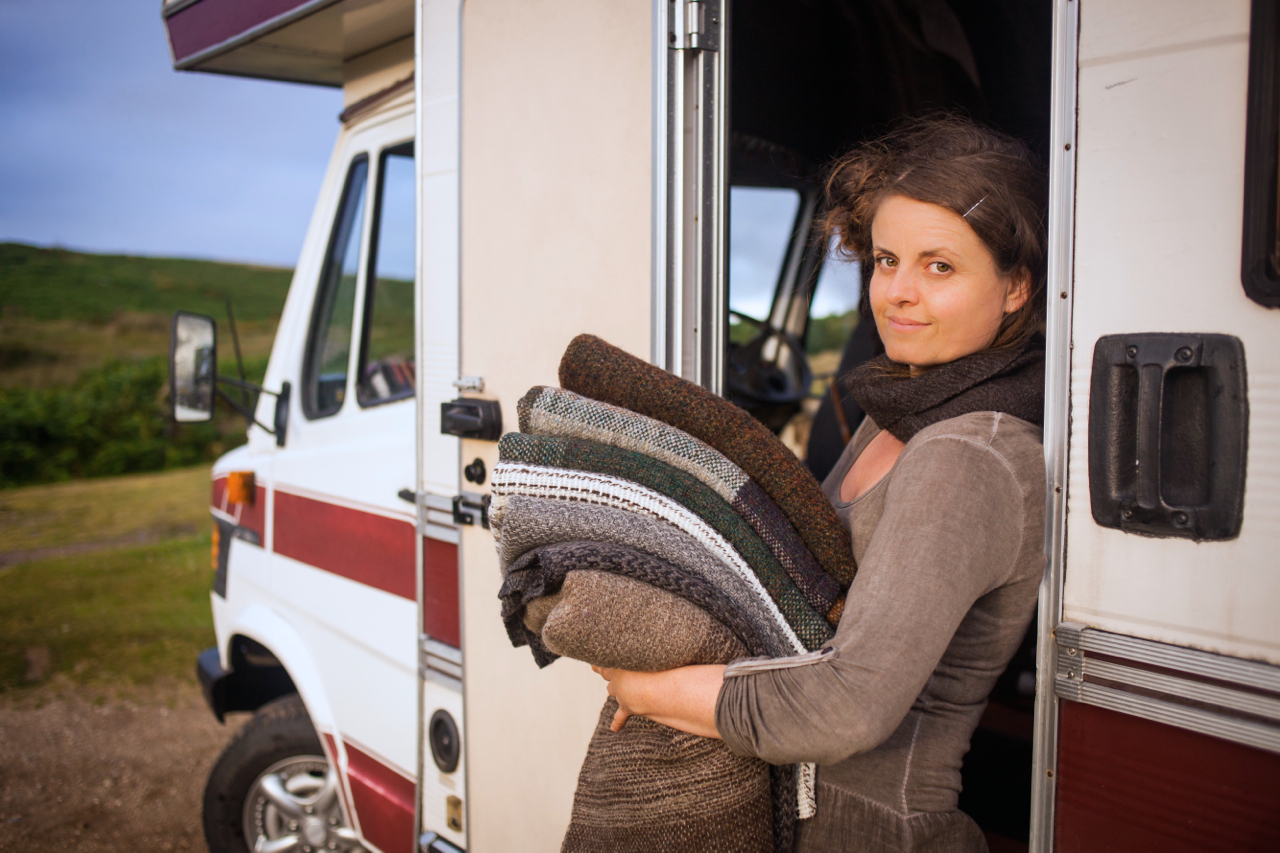
A photoshoot by alicecarfraemultimedia.com for my first big break: an Etsy feature that brought thousands to my shop in 2016

I don’t regret that leap for one minute (and actually I had very little choice). But it was never going to be easy, and of course major things have gone wrong all the bloody way. That and seasonality mean I’ve had to get help (for which I am so very grateful) just to scrape by in these costly big economies of ours.

Naturally I question every five minutes whether local craft can ever be viable, whether my community needs what I produce, or whether there is something better I could or should be doing. And since the answer to all these questions is basically ‘no’ in our current society, I keep on keeping on despite the contradictions. 

I like what I do: it’s relatively autonomous and low-impact, essentially peasant/resilient; it’s creative; it inspires others; it warms others; it’s politically significant, since in our economic context makership is an act of resistance. It’s as much challenge as I can cope with nowadays, and, lastly, I can’t think of a single, meaningful alternative that a landless electrohypersensitive could actually survive. (I can’t even go fruitpicking as long as every other picker carries their damn phone on them, or there’s a mobile phone mast in sight.)

The Grit

Electrohypersensitivity is classed as a disability in some European countries – in France that qualifies you for disability benefit. This makes me feel both relieved and angry: relieved because the predicament is understood in some places; angry because getting sick from diesel particulates does not make you ‘disabled’; getting sick from tobacco smoke does not make you ‘disabled’; getting cancer by glyphosate or asbestos does not make you ‘disabled’… getting sick from artificially high background radiation levels does not mean that I’m ‘disabled’, it means that there’s an environmental toxin being sold as a public good that’s become a public dependency. A post-industrial necessity that is as much a public harm. And the cruellest aspect is that the most sensitive among us (including wildlife) are the least likely to be able to communicate effectively to the wider community because our society’s prevailing means of communication is micro wave digitech, the very thing that causes our problem, so we are often cut off from the wider community, struggle overly with bureaucracy, etc. etc. 

To illustrate how my susceptibility to environmental radiation affects my lifestyle and relationships:

I effectively have a ‘budget’ of about six hours’ a week of artificial electromagnetic field (EMF) exposure, after which my body becomes over-aroused beyond quick recovery (aka relaxation) so that I cease sleeping altogether and, chronically wiped and wired and stretched and anxious and over 40, become ill. (The number of six hours can be more or less depending on how high the levels of exposure are, e.g. from zero inside a granite building in a wooded valley with all lights, appliances switched off 95% of the time to minimise effects of poor earthing in old electrics, to moderate on an exposed hillside where there’s some mobile reception, through to extreme every time I connect my phone – often my only internet access, get a zap from someone else’s device, go into town, or pass a mast.) Just shopping, essential comms and keeping my work going uses up that budget. Going out at all always costs me a few days’ recovery, which I often can’t afford. To actually enjoy any time with friends, they have to be up for switching off and wildy walks in wooded valleys. Very little else.

And I fear how many others are suffering in far worse surroundings than me, and without knowing the cause to be able to make changes, and without means and connections to pursue the crazy workarounds that I pursue; how many will resort to zombifying sedatives, or beating their wives, or psychiatric wards, or drinking themselves to death, or just experience steadily worsening health; how many of us are expendable in the name of ‘progress’, when ‘progress’ means perpetuating and protecting wealth concentration among a few in a hyper-tech ‘arms race’ to the bottom; how many sick people a straining welfare system and diminishing workforce can carry; how far behind the times the medical profession is in their knowledge of this; and how many will have to get sick before national norms for safe levels are reduced and adhered to. (As often, some European countries are ahead on this, thank goodness, namely Austria, Germany and Italy, last time I looked at the stats.)

The Nacre

So, as ever in so many ways, I’m one of the lucky ones. And against the backdrop of housing crisis, gig economy, digital nomadry and pandemic, with help and your moral support and custom, I have woven a beautiful cloth of the silver lining. I have spent much of the last five years combing the furthest reaches of these isles and Brittany for some affordable little nook I can settle relatively autonomously to quietly grow my own food in as much voluntary simplicity as anyone not-quite-hermit can feasibly achieve in this wretched ‘civilised’ world. The quest has been necessary, and it’s been romantic, in between the struggle and the mundane. It’s been dangerous and empowering, as all quests should be, but also confidence-shaking and debilitating. 

I have expended immense amounts of energy – energy that I should have been using to change the world, and to work, grow food, exercise and otherwise look after myself and my community – searching for and researching possible housing solutions in four countries (One Planet Development schemes, co-housing, eco-villaging, shared equity, building plots, planning laws, building materials, ruins, barges, squats, husbands), all of which I ultimately found I simply could not achieve as a feral, lone-female, anarchistic electrohypersensitive on a tiny income.

The Pearl

At last I’ve found a small, very roughly habitable, rubblestone cottage buried in a quarter acre of eight foot high brambles, with another half acre of tree-fringed glade, in a pocket of properly rural countryside, with no mobile phone coverage and friendly neighbours, that will be mine for a very modest £55,000. It has a new roof, a new woodburner, free water, and a very basic bathroom and kitchen. Crucially, there’s space for a proper workshop with larger looms, and for a dye garden, and possibly even a couple of fleece animals.
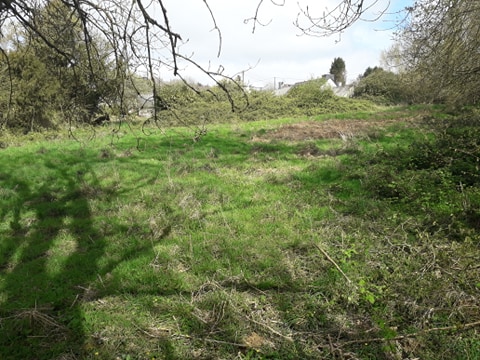
This sleeping beauty is too buried beneath the brambles for a photograph (which would reveal a not-particularly-beautiful, cement-rendered façade)

As well as the normal surveying process, I’ve had both a builder’s and an architect’s advice on it (friends in the right places, thank you Chris and Chris). It is structurally sound enough but there is work to be done to deal with damp and lack of use; it has old, skeletal electrics, no boiler, and an old, legally obsolete, septic tank. 

But I have tools, skills, books, contacts and courage; I know how to rough it, wing it, mend it and make do, and anyway ‘modernising’ isn’t really in my vocabulary; my way is more romantic – grow wax myrtle and make my own candles; rig up a bicycle to power my laptop and eventually go without; shun even photovoltaics – if I can.

It’s not perfect. Drawbacks include a not-very-walkable route/distance to the nearest market town but advantages include land that gently slopes to the south west; the house being at the top of the site, not overlooked; the property having its own spring as well as the shared village one piped into the house. The house itself has some nice features among the less nice ones, and ticks the essential boxes (especially no mobile coverage) where in five years of searching nothing else has. 

The Next Step

I’m researching forest gardening, regenerative micro-agriculture and permaculture. Fleece animals and dyestuffs from my own dye garden would build on my existing livelihood, as well as developing food production in case of community need. In fertile lands like these, and in the face of climate catastrophe, we need all the primary producers we can get in our precariously obese ‘service’ economies. Keeping earthskills alive is a matter of survival of the species.

No falling in love until it’s signed for, though it’s mine for the signing. I hope to move in this month or next, after putting down the deposit – the vendor knows I’m in sore need of a home before the nights get cold and dark.

The only problem is that I don’t have £55,000. Nor am I ‘mortgageable’, an advisor told me. I’m terrified, as ever, but I do have a plan.

The Plan

  1. The bank has, irresponsibly, offered me a normal loan of up to £30,000. Repayments are scary as hell on a tiny, erratic, arts income. And in my analysis, since my bank calls itself a mutual but is not, this money-created-as-debt-at-interest-by-those-privileged-with-a-license is a locking mechanism for our society’s material ills. But so much less choice than we like to think: shoulder the poverty tax and compromise my principles in the short term the better to keep fighting in the long term.
  2. Blessedly, there are some family funds I can draw on in addition.
  3. I have things to sell: my retro Mercedes; a yurt (currently backup accommodation but soon unaffordable luxuries); lots of handwoven garments and many more to come; plus two very fine musical instruments (if I can content myself with lesser versions).
  4. Once settled, I can be more productive: in the last seven nomadic years, there are seasons when I work a steady 45 hour week, months when I work a 50 or even 60 hour week, but times of upheaval in between where I barely work at all: beyond my control, exhausting and disruptive. (Life on the road is not a steady amble from one beautiful hilltop to another; there are vast swathes of inhospitable terrain – hostile territory, even – in between the very few remaining wildy refuges. Especially if you’re electrosensitive. Also, too often I have had to rely unsustainably on family and friends, who can barely accommodate my electrosensitivity themselves.)
  5. There’s a gap in the local market for lawnmowing for secondhomeowners, which I could risk destroying my soul to do if bank loan repayments became really scary in my low season – a scythe would make it less environmentally loathsome and more of a campaign stunt. There’s also a gap in the local market for holiday cottage changeovers, ditto…

…and finally, you.

The Solution

Given the vagaries of a craftsperson’s income, to reduce the amount I have to borrow, I’m appealing to you. I’m launching a crowdfunder. This is hard to ask in our society (though in the Once and Future Village, friends, neighbours and family would all help each other build their homes if they could)…

Please would you help me buy a safe, stable, longterm home from which to further my (I hope you’ll agree) worthwhile activities? 

The Crowdfunder

If so, if you’re reasonably comfortable/secure yourself, and not stretched too thin in over-giving, or stuck renting and resenting, or debt-stressed and floundering, as so many are… if so – and I can’t type a heartfelt enough ‘THANK YOU in advance’ – if so, please go to my crowdfunder page to make even the tiniest donation. I hope to raise £20,000 before November 30th, but sums will still be invaluable after that as I deal with poor drainage, decrepit septic tank, lack of boiler, rotten floorboards and stairs and so on. Your gift would make it work where without you it’s very, very touch and go. You can donate here: Rerooting: a home for Eloïse.
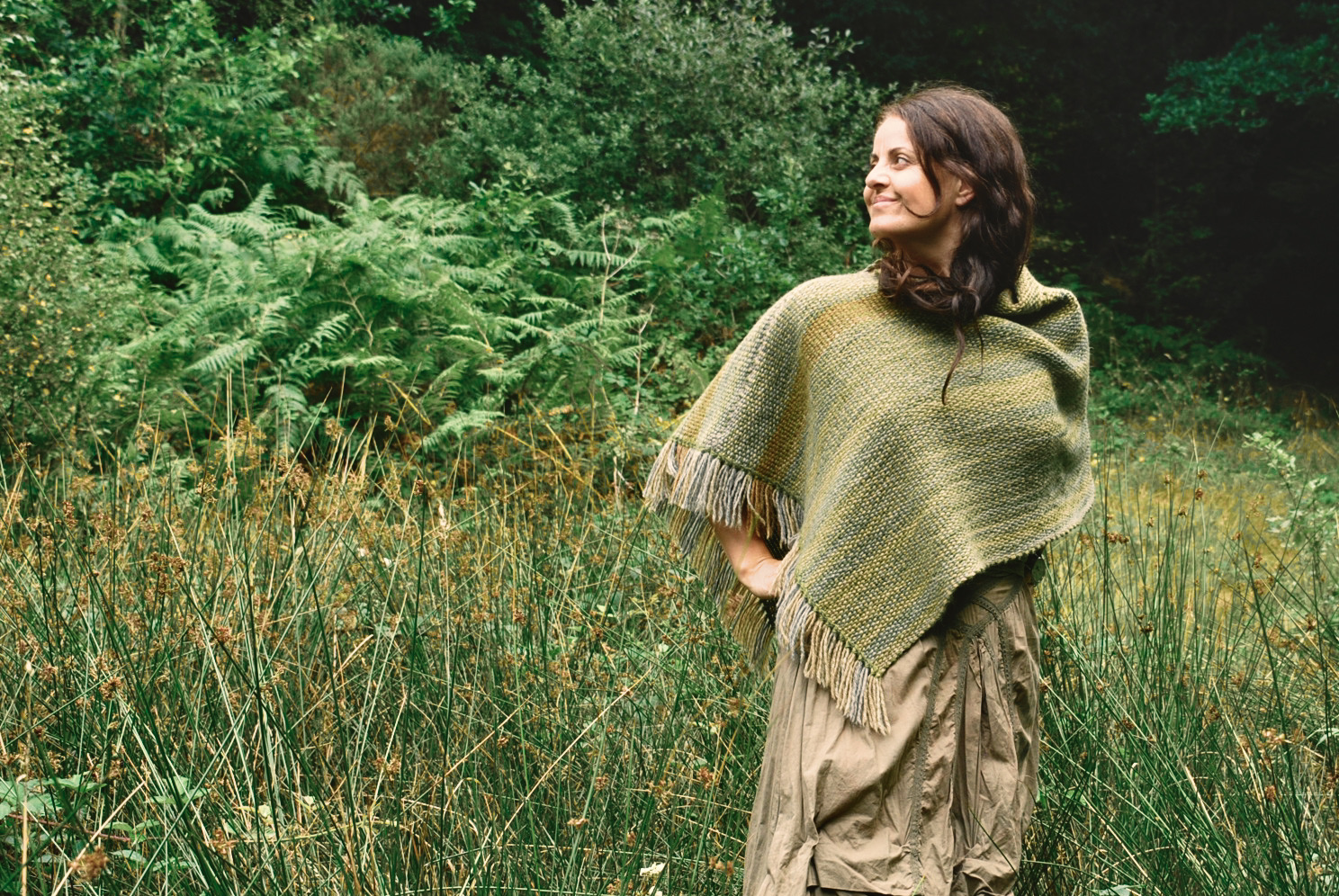
Weaving the year in these isles

I’ve been away from my blog for some months, weaving and publicising (and househunting) and writing for other people’s platforms and too fired up with ideas to keep up with them all here. I apologise! Do please follow on my other platforms: Instagram for daily images of works in progress and nuggets of ideas; Facebook, the central hub, with weekly musings, pictures and links to products; Pinterest for occasional display boards; lowimpact.org and noserialnumber.org for political and environmental articulations of craft economics; and of course the These Isles shop where the weavings themselves are listed for sale as I make them.

So this final entry of 2018 will be a round up of the year – the ideas, the travels, the tensions, the weaves…

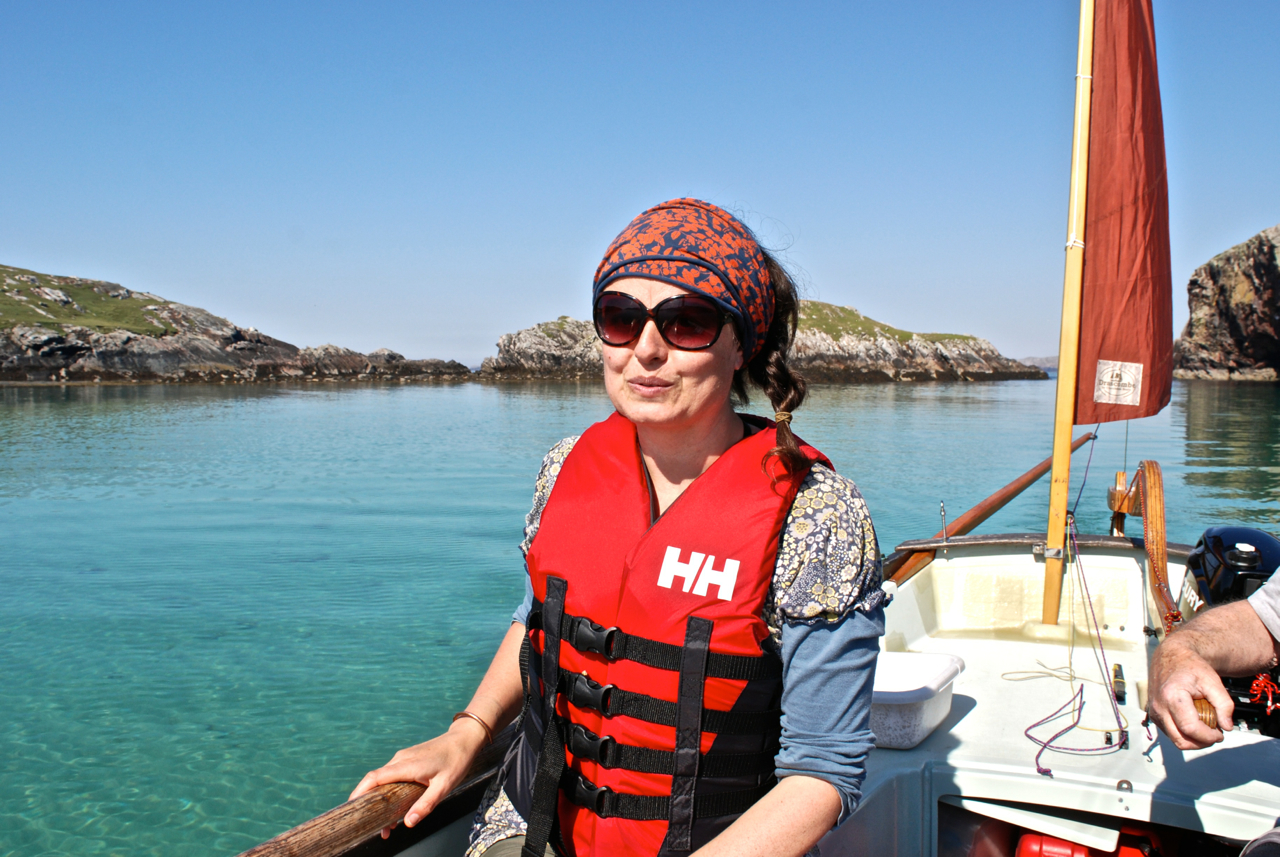
Me on Iolaire

In a tiny boat in a beautiful bay of islands in the Outer Hebrides in summer I went fishing with some dear friends who go out specifically to catch their week’s supply of protein. I caught and killed my own fish for the first time, and I experienced that feeling for which henkeepers so loathe foxes: after some fruitless trips, some hours of disappointment, and some hours of seasickness and cold, on finding a shoal of very large mackerel, the brutal, maniacal drive to catch and kill as many as possible at one go. The predator making hay while the sun shines. And, though I like to support what I consider good food production (tiny scale, mixed, organic farming and wild hunting and gathering), the experience of this startlingly feral drive pushes me a little back towards vegetarianism – or should it be veganism, for the absolute stand that the planet perhaps needs a critical mass of us to take now in order to avoid or mitigate climate breakdown?

I’ve been reading Monbiot a lot, and I’ve been homehunting in sheepwrecked landscapes historically cleared, often violently, of people so as to make way for the wool on which we built our empire and on which my livelihood now depends. Ouch. Tiny, scattered, determined, island community members cling to each other wilfully and creatively – crofters, artists and fisherfolk in remote, difficult, treeless terrain. In the Hebrides there is less counter culture, but perhaps less need for it, as these people are still well aware of the essential importance of each other, of land, and of craft. However, holiday home-owning in the Outer Isles has contributed to the largest price spike anywhere in the UK in the last two years, and all that would be vaguely within my reach is in too poor a state for my financiers to consider. Also, after the Caribbean weather vanishes in July and galesome, wet, autumn sets in, I realise for the first time in my life that I do not want to live alone far from the nearest town, especially where the landscape is so inhospitable now to all but grazers, and the winter days so short.

This is very much a revelation: I was brought up on a shoestring but renting in beautiful places was always prioritised, was what I knew and loved and what I always sought for myself too, even in solitude, and always envisaged for myself forever. But renting feels exploitative to me, and no longer a happy housing solution. And buying rurally is unaffordable for most of us. And then this change of heart: Stornoway’s welcome, with its arts centre, lively pubs, and extensive woodlands by the harbour and town centre, altered my path quite radically. I’ve come to want what most people want: the daily dog walks in the trees, with the shops, market, music and social life also within walking distance.

Sadness and anger for centuries of wealth-concentrating policy that has made the English countryside (especially) largely inaccessible to the many, and pretty lonely to the few, with communities significantly eroded. The Land Workers’ Alliance, Simon Fairlie et al continue to fight for the rights of young, alternative farmers to make their sustainable projects feasible by being able to live on the land they work. So many of them are still thwarted even in their agricultural pursuits by conservative planning laws, and buying land in my native England would certainly not solve my own housing problem. (Although, amazingly, the more philanthropic Scottish government and Crofting Commission actually pay people to take on land and build, personally I do not feel equipped to face this alone. The One Planet Development project in Wales is even more farsighted – truly radical and visionary – for those of you with more strength and resources than I.)

So, a lover of space, wilderness, silence, dark skies and rewilding, my views shift: whereas my first trip to Ireland saw me dismayed at the scatter of bungalows throughout much of the countryside and the lack of wild between them, the socialist in me is glad now that more people have access to land and rural life. For disconnect with land is surely the root of all of society’s ills…

I’m currently reading Paul Mason on postcapitalism, radically foreign yet resonant: is the urbanite so disenfranchised from the land that land will soon no longer be one of the three pillars of economics (along with labour and capital)? He seems to be positing that these three may be largely outcompeted by a knowledge economy via info-tech, and that these successors are more equally distributable among all the networked individuals of the world, the order of which he sees as undergoing an overarching battle between complex network and oppressive hierarchy. Thus he heralds the emergence of non-enforced communism as originally envisaged by Marx, and I am forced to question whether my own dreams of land ownership root nomadic me, of all people, in an old, oppressive order. 

But how to mend the psycho-social and cultural disconnect compounded by capitalist economics and surely not healed by this new route yet further divergent from land? Infrastuctural collapse brought on by economic crash and climate breakdown will surely throw survivors back into whatever remains of fields and woods. Personally, professionally and politically I gravitate towards the lowest tech, land-based survivalism, but ideologically I cannot ignore the democratising and egalitarian potential of the high-tech – an incoming wave I’ve welcomed, jubilant, in both education and politics, to name just two examples, as the complex chaos of social media glistens its possibility for overthrowing the archaic, hierarchical paradigms.

Mason suggests that a gift-like economy (though so far he uses other terms) of infinitely and freely replicable info-goods enabled by networked media will elude profiteering and supercede the markets. As he explains it, it sounds like another route away from the monopolising feudalism of debt-money. I wonder how the knowledge producers will put bread on their tables (and most people in the arts already know how that feels) – but I’m sure that subsequent chapters will examine this satisfactorily. (It’s great writing, and great politics; do follow him.)

Back to my own profession: a London designer of African origin has just approached me for some chunky, earthen cloth handwoven in native Celtic wool for his menswear apparel. We are both excited at this opportunity to explicitly connect fashion to land via craft, and the diverse ecology of our possible collaboration.

So those are the ideas, and here are the weavings through the year.


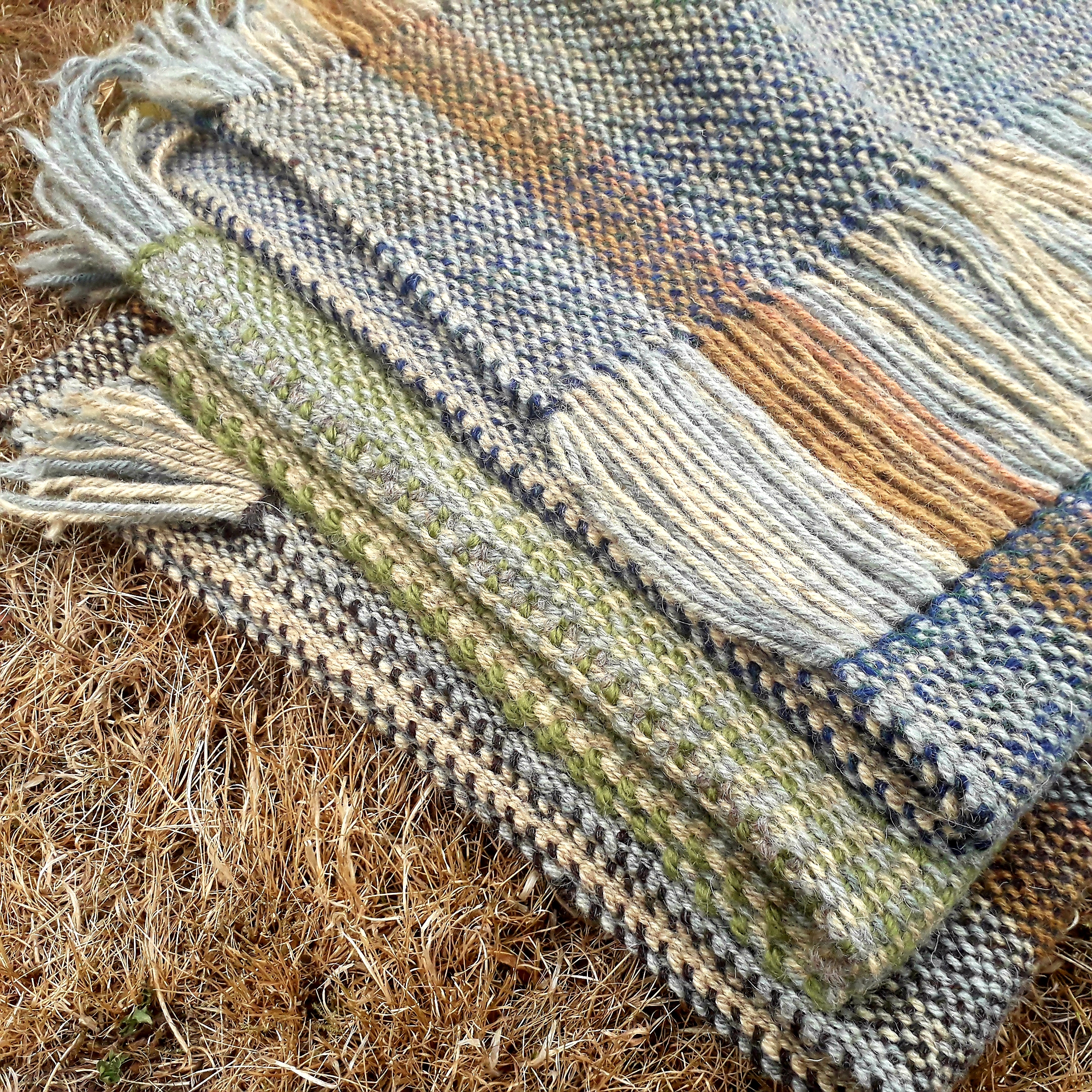
January. I started the year in Devon, and wove some rustic cloth à propos of the silver-grey bark of wintry trees in the woodlands where I walked Murph. Some of the wool was my favourite Scottish island tweed that lent subtle but startling multicolour to the natural and/or undyed greys and rabbits. The year has turned and two of these three scarves have sold. The softest, plainest, wintriest one remains, gentled by a little Alpaca.


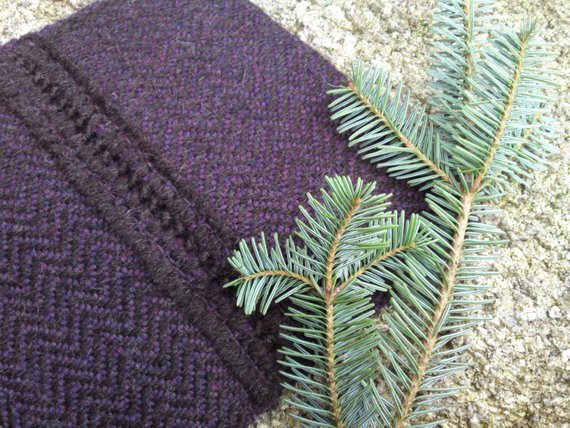
February. Van life means you have to keep moving whether you want to or not, since it is easy to outstay your welcome, even where there is one. I went to Brittany and spent time with both mor and koat – sea and forest. Here is a soft, wintry snug pictured on a boulder in woodlands of the Armorique National Park, Finistère.

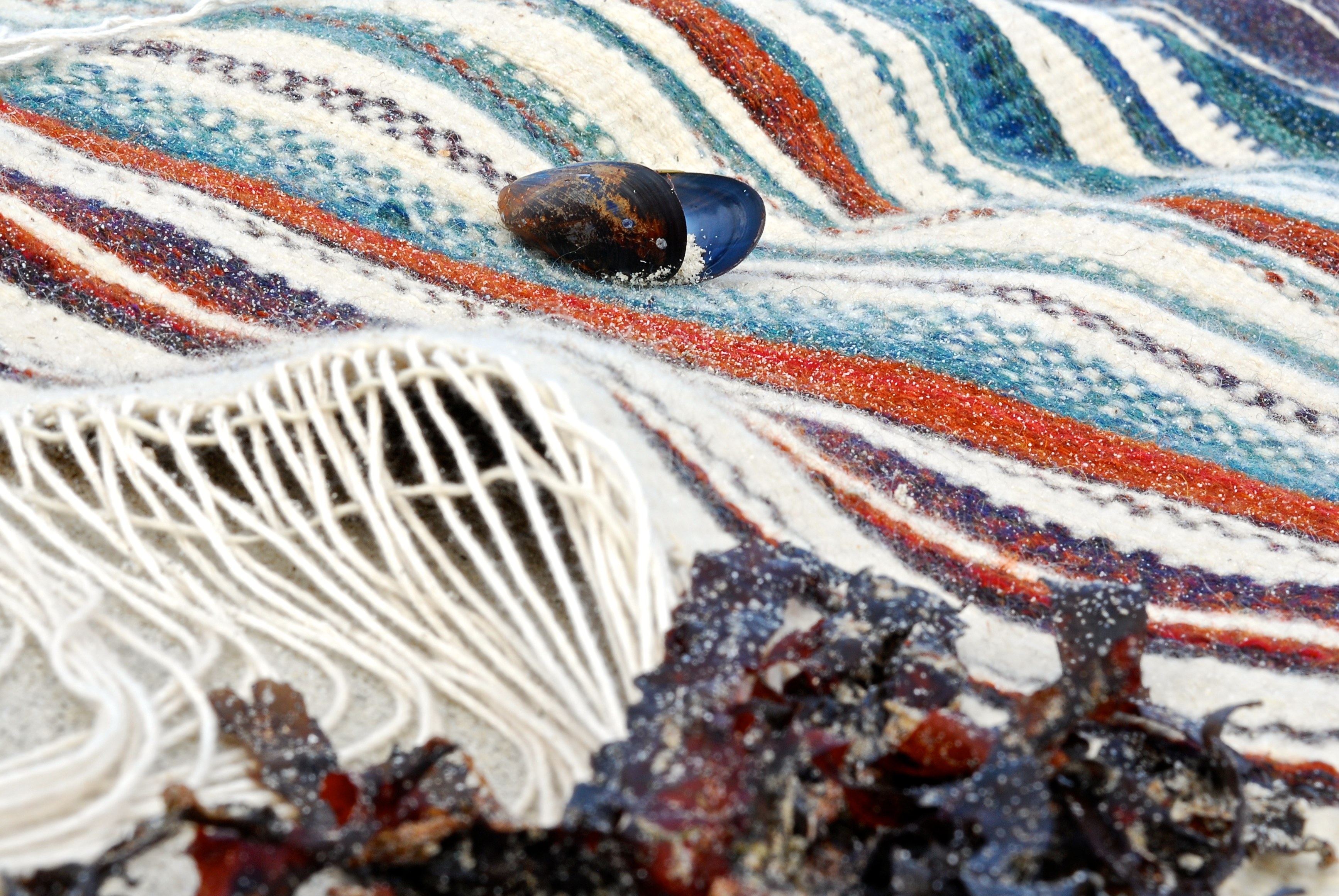
March. Still in Brittany, I resumed the seascape weavings. Here are some pictured on huge expansive beaches, where chilly, windfraught photoshoots often required pinning weavings to the sand and styling the practical improvisation into a vignette. I notice how the Atlantic coast, jewelled with the odd white beach all down, changes gradually from the Western Isles of Scotland, with its rocky moor and bog and mountains on gneiss; the Inner Hebrides, Argyll and Bute, gentler and prettier, with a little dogged ancient oak forest even on the Western seabord; Wales with its moorlandy cliffs like the granite tumbles of North Devon and North Cornwall; South West Cornwall, more wooded, with softer moorlandy headlands and the beginnings of the rose granite; Brittany with these moorlandy headlands, rose granite and the beginnings of the mediterranean pines that prevail down the French Atlantic and all the way to Galicia. I haven’t seen the Portuguese coast, and I wonder…


April. The sun came out hot in Brittany, but I returned to Devon. Thinking about how best to use the most local, least processed wool, I began weaving rugs. The most local, least processed (undyed) wool wove itself into the most successful of all those made so far. Telling me something, perhaps.

Undyed, native breeds from these isles: rug for sale at https://www.etsy.com/uk/listing/624817605

May. I began to gather together for a trip back to my first landing place after going on the road: the Isle of Lewis. They were having a heatwave. Drought made the bog less colourful – I particularly missed the red sphagnum moss – but the sea more inviting. Weaving the colours into rugs was heady, though the technicalities proved frustrating. 

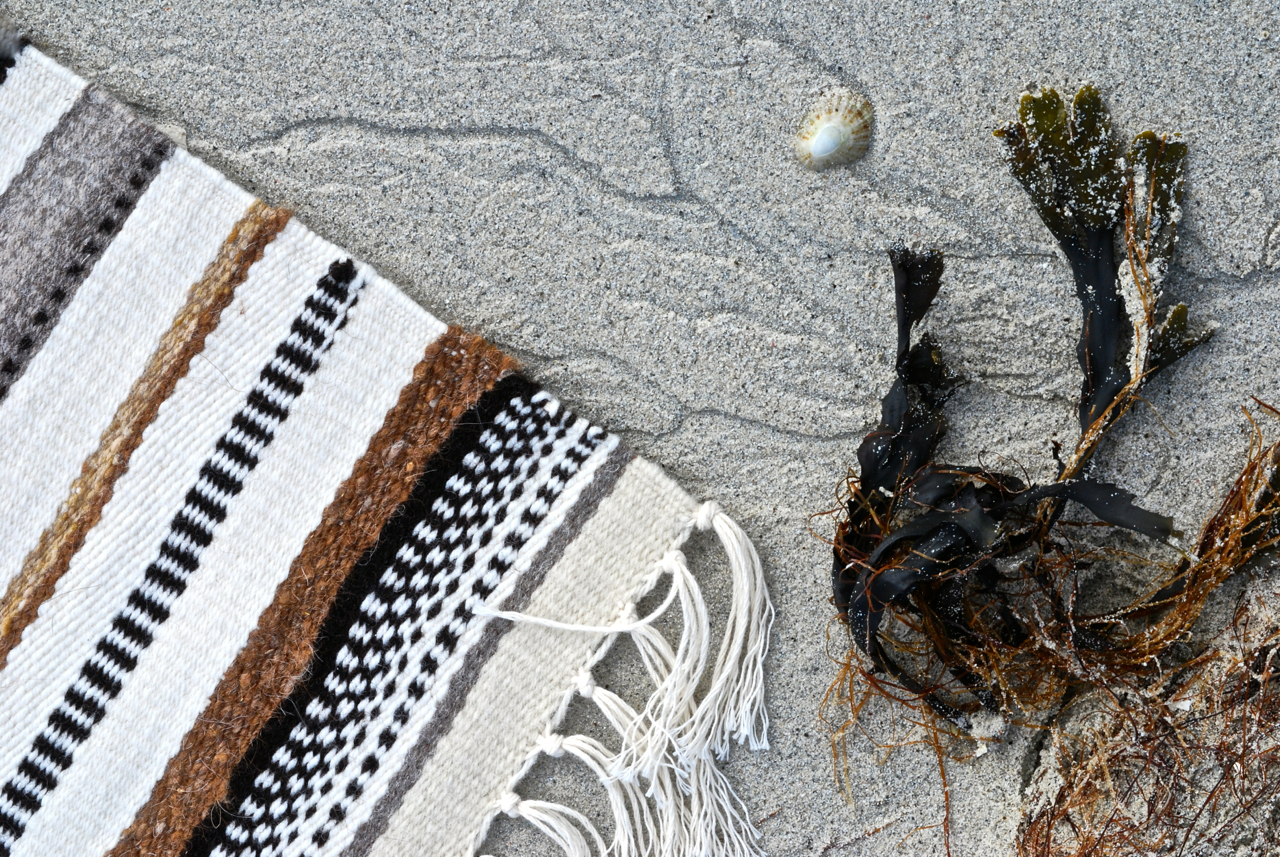
Bladderwrack rugwreck wallhanging for sale at www.etsy.com/uk/listing/629330975

June. When the weather broke in the Outer Hebrides, storms brought in heaps of orangey rusty red, purple and black bladderwrack; rocks black with lichen reflected steel and white skies. This little slipway was all but reclaimed – the beatuful romance of unobstrusive workmanship that enhances a wildy landscape. The colours for this rug absorbed me totally, and are a combination that stays with me still.


July. In the height of summer on the Isle of Lewis, the rare meadows behind the sand dunes of the whitest sands burst into bloom. The acid soils are fertilised by windblown lime to create the green, cerise, yellow, blue, purple and white machair effect unique to such parts of Scotland and Ireland. I camped in them, walked in them and wove in them to my heart’s delight.


August. Horizontal rains ripped the Outer Isles and drove through every crack not only in my old van but also in my friends’ very new van. I had remembered that the Hebridean dampness was less bothersome than the Devon dampness I was brought up with, because in the islands, in between downpours, galesome winds at least blow in through the cracks and help dry things out. This summer though, the rain barely stopped and the wind just forced the water in. I kept my recent memory alive though of rusty red weed, rusty red sails, rusty iron rings and the skies reflecting their deep blue into the Atlantic, and wove one of my best shawls to date. I recently packed it up to send to Oregon, where I’ve heard that their rugged coast may be as characterful – and possibly a little bit as Celtic – as ours.


September. Still in the Outer Hebrides but after eight months of unusually slow trade and a few months of dead-worried publicity drive, a couple of magazine features came together. One, by Carol Ann Strange, will depict my travelling craft life, to come out in Coast magazine I’m-not-sure-when. The other, by Kate Stuart in No Serial Number magazine this autumn, draws the threads of the poetry and the politics together in an invitation to the Green Cloth Collective – a group for environmentalist craftspeople who see their makership as an act of resistance.


October. I had hoped to find suitable bricks and mortar in Stornoway by winter. However, four months’ relentless searching revealed only wrecks within my reach. But that port town where my heart sings; that little harbour where the Drascombe is moored; and that little slipway where I walked Murph every day remained alive in my mind, and the first of my winter smalls were this harbour snug, harbour scarf and harbour cowls. (The scarf sold straight away, but the others are still in my shop as I type – don’t delay!)


November. Back in Devon again, I watch the wooded hillside opposite go through its zenith and then fall wintry. There are regal oaks, scrubby gorse and some other native planted saplings as a piece of this prime but tiring agricultural land is being allowed deliberately to rewild. Most noticeable are the swathes of silver birch with their platinum trunks and red-purple brush. Some of my favourite spots in the Highlands, islands and Ireland are characterised by birch. 


December. Still static in Devon, flat out trying to make my most seasonal of crafts earn me a year’s income in what may, in terms of sales, only be a three month year. (I’ve been pleasantly surprised before at the length of my season, but this year has been different, and very stressful due to slow trade Jan-Aug.)

I add some new postcards to a large reprint, and get some, ahem, very swanky cards printed on recycled cotton. I squeeze out a few more weavings, though decide to concentrate on selling more than making in the peak of this peak season. I invest in some Facebook advertising (corporate, boo!) which increases my traffic by orders of magnitude, and have a consultation with a nice Dub at Facebook Ireland’s HQ about targeting my advertising. I’m getting slick, now, me #requisiteYorkshireaccent.

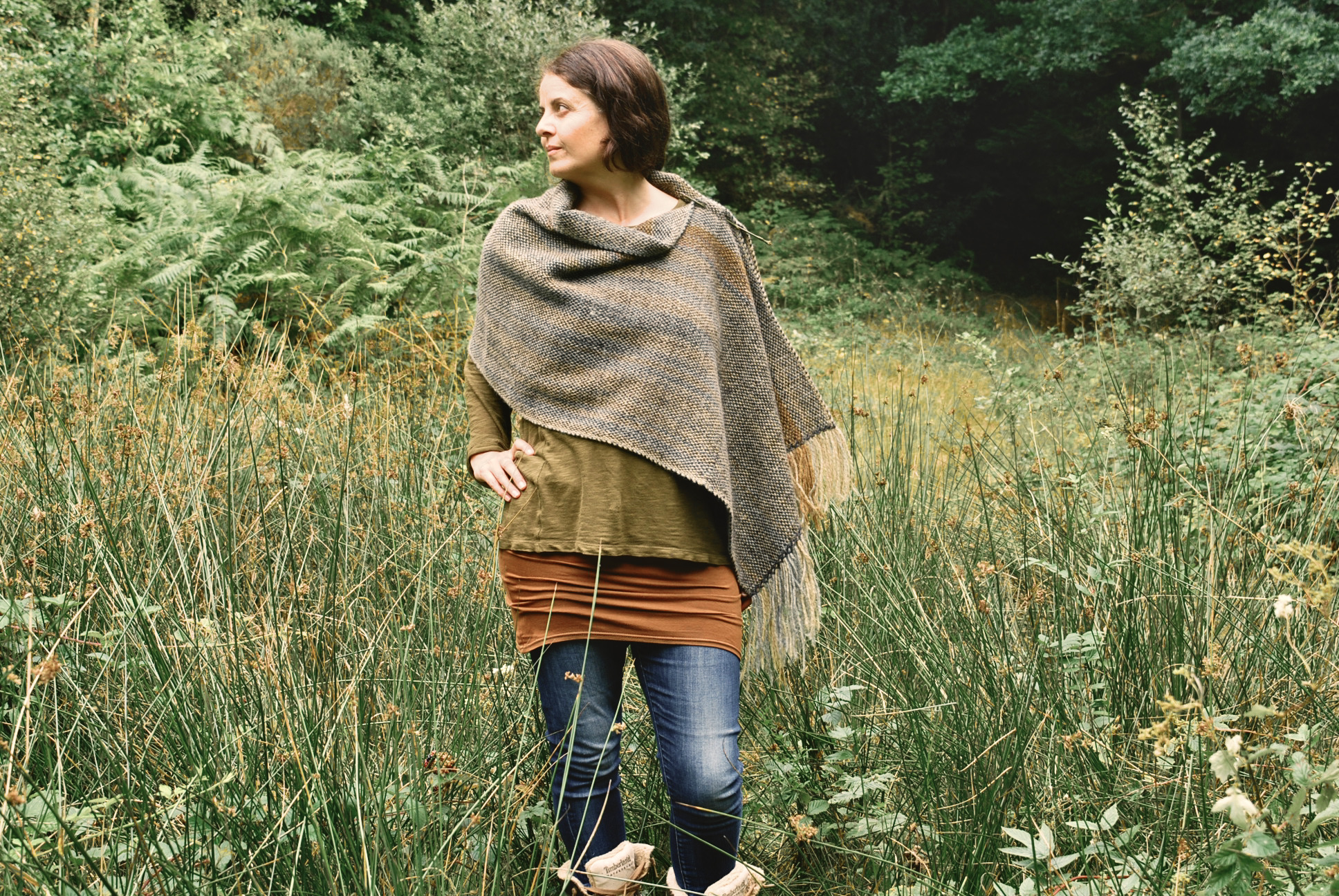
I also revamp my shop with a new, high speed photographic style: I figure that you may wish to see my weavings worn in order to imagine what they might look like on you, and not just what they look like in the landscape!


And so we wish you a Merry Christmas, Murphy and I, and thank you for your support, and look forward to ‘seeing’ you in the New Year.

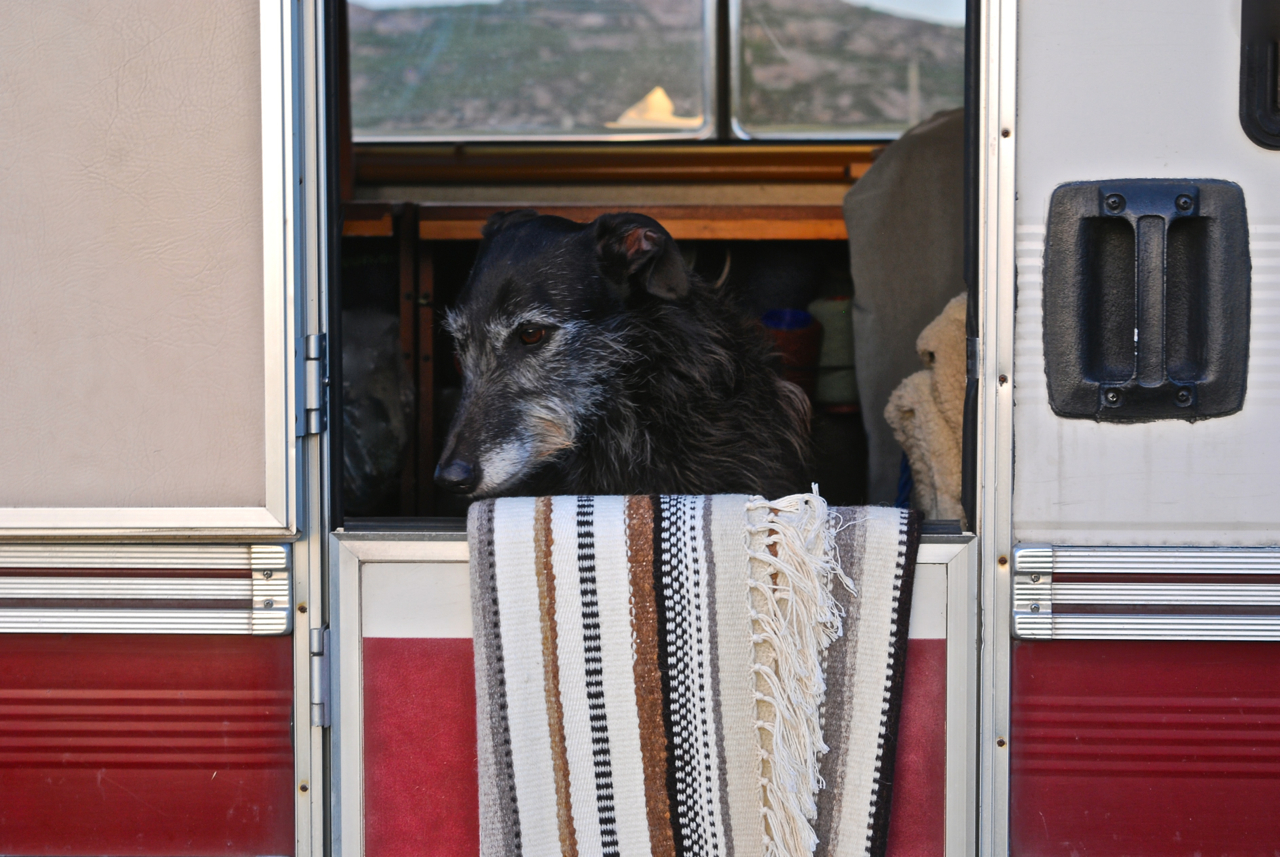
Murph in van w rug close landscape by Eloise Sentito of These Isles